Until a few years ago, I’d heard the name Dorothy Sayers but never quite knew what she wrote. Then I happened upon a Lord Peter Wimsey story in a mystery anthology and the character and story has stuck with me ever since.
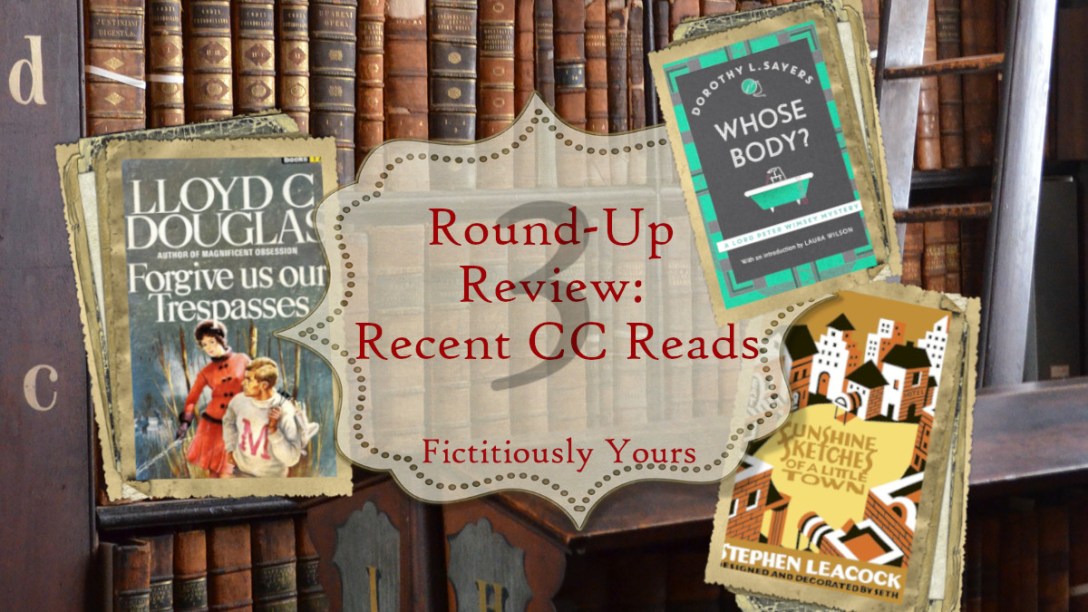
Keeping my eye out for the rest of the series, the 3 for $10 shelf at Chapters caught me at a weak moment. I got the first and second Wimsey books, Whose Body? and Clouds of Witness, along with Stephen Leacock’s Sunshine Sketches of a Little Town.
I somewhat recently read Whose Body? and Sunshine Sketches, along with another Classics Club pick, Forgive Us Our Trespasses, so here’s a round-up of those three reviews.
- Whose Body? by Dorothy L. Sayers
- Forgive Us Our Trespasses by Lloyd C. Douglas
- Sunshine Sketches of a Little Town by Stephen Leacock
Whose Body? Dorothy L. Sayers
I was already introduced to the character because I read book 11 of the Lord Peter Wimsey series, The Nine Tailors, when I found it in a local free library. But Whose Body? has that first book introductory feel that gives more of the initial characterization upon which Lord Peter’s development later is built. It establishes Lord Peter’s unserious approach to life, his ennui, his general laissez-faire attitude (look at me pulling out all the French terms), his English sense of fair play, and his PTSD from serving in the First World War. Real second son energy.
We are also introduced to his “man” Bunter, valet and PA extraordinaire, who assists with everything from the mundanities of dress to bidding on valuable book collections to interviewing suspects and informants. An admirable Jeeves.
“Apollonios Rhodios might be worth looking at… you can stick the book on the library list if you like. His book on crime was entertainin’ enough as far as it went, but the fellow’s got a bee in his bonnet. Thinks God’s a secretion of the liver – all right once in a way, but there’s no need to keep on about it. There’s nothing you can’t prove if your outlook is only sufficiently limited.”
Dorothy L. Sayers, Whose Body?
The tale is winding and complex, though not long, consisting of two parallel mysteries that Lord Peter and his friend Parker on the police force are trying to solve. One is the appearance of an unidentified body in a tenement bathtub and the other is the disappearance of a wealthy trader from his upscale home. They switch mysteries, as Peter is convinced they must connect somehow. In the process, he encounters a near miss with an elevator shaft in a hospital mortuary, a dull wait in a clerk’s office, and a crisis of faith in which his motivations and intent for solving the crime are questioned.
He wants a Columbo ending, where he and the murderer have a mutually appreciative handshake and say, “Nice match, old sport.” In other words, he’s viewing the people involved and their lives as a game for his own amusement. Sayers is able to explore this potential flaw early and lightly, without getting too mired in the grim realities Lord Peter is forced to face.
Overall this is a good introduction to the character and his crime solving start so I’m interested to see how it develops through the subsequent books.
Forgive Us Our Trespasses, Lloyd C. Douglas
I think I started this book three times before I committed to reading it. Which sort of fits because Douglas starts the book twice as well.
The first story starts with a girl and her family, descriptions of her relationships with her siblings, their father’s alcoholism as well as his legacy as an artisan of finely crafted furniture, and the girl we suppose is the main character falling in love. Cut to a secret marriage, a separation for the husband to “seek his fortune,” a fraught pregnancy and the main character dying in childbirth.
So, a couple of chapters in we realise the main character is not in fact the main character–she’s just backstory for the main main character: her son, Ferdinand. But that doesn’t mean the preamble is extraneous. It is integral to how Ferdinand’s personality and arc develops.
Cue the second story start.
Raised by his strict aunt and her husband, a hypocritical minister, Ferdinand comes to some bitter conclusions as a youngster and goes on to hone his skills as a satirist and critic through college and then into his career as a newspaper columnist. Ferdinand goes through various jobs, various social groups, various infatuations, even the First World War, and has something scathing and pointed to say about all of them.
The Times-Telegram…was in a grand state of excitement. Everything was speeded up, soaped, scraped, scoured, scrubbed, sponged, shined. High efficiency prevailed.
Lloyd C. Douglas, Forgive Us Our Trespasses
Reporters put fresh ribbons on their machines… cleared their desks, bought a new hat. The girls at the Want Ads counter stopped doing their nails in the presence of customers. Linotype operators tried valiantly to break themselves of the reprehensible habit of tossing pied slugs back into the pot. Windows were washed in the composing-room. The devil wore a clean shirt.
Once this story got going, it really got going and I was engrossed in the misanthropic career of this witty protagonist. Alas, love comes to redeem Ferdinand, but not in the direct or maudlin way one would expect. Several hard separations, hard conversations, and facing hard facts about the incompatibility of two opposing perspectives on life take place before our hero figures out that he has to “work out his own salvation,” so to speak.
I vastly enjoy Douglas’ writing. He has a brilliant wit and incredible sense for complex characters, developing situations, and impactful dialogue. He considers questions of religion and society that are grounded in his novel’s historical context but still ring true today inasmuch as they are human concerns. He also writes conflict in such a satisfying way, presenting both sides with their best arguments, that it’s difficult to see how resolution can possibly be achieved.
But, it’s a novel, so of course resolution is achieved, in somewhat mystical, extrasensory Douglas fashion. I loved a good 85-90% of this novel, though it is unfortunately framed with a somewhat protracted introduction and what I thought was a disproportionately abrupt ending.
Sunshine Sketches of a Little Town, Stephen Leacock
Before it was a Barbie fairy story, Mariposa was Stephen Leacock’s fairy story. Mariposa is a fictional town in rural Ontario where characters and hijinks abound. From the money-making business schemes of the local publican, the amorous mishaps of the local clerk trying to court a judge’s daughter, the annual sinking of the riverboat while the band played on, to the more melancholy phasing out of the aging minister and the peril of a financially devastating fire, this book of sketches has it all.
Pupkin would never have thought of considering himself on an intellectual par with Mallory Tompkins… Mallory Tompkins had read all sorts of things and had half a mind to write a novel himself–either that or a play. All he needed, he said, was to have a chance to get away somewhere by himself and think. Every time he was away to the city Pupkin expected that he might return with the novel all finished; but though he often came back with his eyes red from thinking, the novel as yet remained incomplete.
Stephen Leacock, Sunshine Sketches of a Little Town
I enjoyed the episodic nature of this book, which started with each chapter encompassing its own story. The tales of the amorous local clerk and the minister’s story both spanned several chapters, which helped give those storylines and characters more development and got me invested in their lives. The pace and choices were particularly effective in the quieter tale of the minister, which really pulled at my heartstrings. I also remembered the minister as a minor character in Leacock’s “sequel” book, Arcadian Adventures with the Idle Rich, which I had read before.
My discovery of Leacock in the last couple of years has been a fun experience and I’m glad I was able to find this more well-known early work of gentle (and sometimes not so gentle) irony.
This has been my nineteenth, twentieth, and twenty-first Classics Club book review! Check out the rest of my list here.
 Fictitiously Yours
[…] Whose Body? (1923) by Dorothy L. Sayers5 […]
LikeLike
The 3 for $10 Shelf sounds like a winner!
I’d be happy never to read another Dorothy L. Sayers book again, but it sounds as if you’ve had the opposite (and intended) reaction to Lord Peter Wimsey.
The Stephen Leacock book sounded so fabulous that I looked him up after your review and saw that Sunshine Sketches, along with loads of other fiction and essays are available from Project Gutenberg. I’ve downloaded Sunshine Sketches, read the first paragraph of the preface and I’m hooked! Hoping to find a hardcopy but if I have to I’ll read this from the screen.
LikeLike
Oh that’s interesting! What don’t you like about her books?
I read a couple of Stephen Leacock books from Project Gutenberg, too! I love that they’re available that way. Hope you enjoy it!
LikeLiked by 1 person
Sorry, I should have said why I didn’t like the books. It was the character’s accents that annoyed me most, Lord Peter droppin’ his endin’s and another character dropping ‘is ‘aitches, but I also struggled with some outlooks that hadn’t aged well.
Project Gutenberg is such a treasure 😀
LikeLike
That’s fair! I also noticed that tendency of Lord Peter’s but it doesn’t bother me too much. And of course the dated outlooks can be that much more of a challenge if you already don’t like some of the writing quirks. I’ll continue to enjoy them, but to each her own! Thanks for sharing your reasons.
LikeLiked by 1 person
The Nine Tailors is the only Lord Wimsey I’ve read, but I reviewed one of her religious works for Classics Club not long ago.
I’ve enjoyed the two Lloyd Douglas novels I’ve read, but I don’t know if I’ll get to any others. I’ll keep this one in mind.
I have a Stephen Leacock planned for my next Classics Club list! (Nonsense Novels)
LikeLike
I started with The Nine Tailors because as I mentioned I found it in a book box, but I’m really enjoying getting the full Peter Wimsey saga from the beginning! I have also since writing these reviews read the second book, Clouds of Witness, and she does some very interesting things with character development and even what I would venture to call social commentary. I’ll have to check out your review of her religious writing! I understand she did quite a lot of that as well.
I can take Douglas in small doses–since The Robe became one of my absolute favourite books, I’ve read a fair amount of his others and while I enjoy them, they aren’t all equally meritorious to re-read.
Nonsense Novels is a treat! Great little stories of whimsy (not Wimsey). Hope you enjoy it when you get to it! I look forward to that review.
LikeLiked by 1 person
[…] never doing single book reviews to mostly doing book reviews, done a few book tags, joined the Classics Club… I still don’t really know what I’m […]
LikeLike
[…] bought Clouds of Witness in the same 3 for $10 haul that I got Whose Body? In the second novel, Sayers brings the crime and its implications to the heart of Lord […]
LikeLike