
April, May, and June reading.
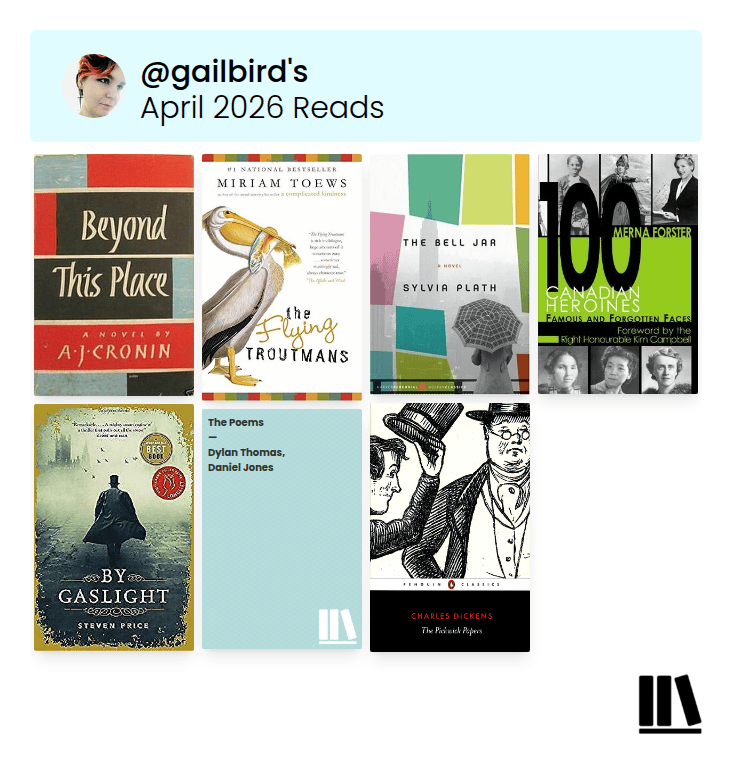
Beyond This Place, A.J. Cronin
When a young man discovers his father, who he has believed to be dead all his life, is actually in prison for murder, he determines to find out what he can. His investigations turn up a sordid conspiracy and threaten the rise of powerful politicians whose careers could be destroyed by the revelation of what really happened.
A.J. Cronin has the touch for putting human interest into unexpected situations. I didn’t go into this thinking it was a mystery novel, but it certainly is. That is not the ultimate tone, though, as even when justice prevails, it comes too late for some things to ever be the same.
The Flying Troutmans, Miriam Toews
This was a good first Miriam Toews book for me, I thought. It’s funny, sad, adventurous, and has a good buddy road-trip vibe to it. The difference is that the buddies are a young recently single woman and her nephew and niece, and they’re going to find the kids’ father in an epic quest across America.
The Bell Jar, Sylvia Plath
Sylvia Plath’s only novel, it is certainly a memorable one. I don’t know what I expected but it wasn’t the slow trajectory of a young college age girl from a working “holiday” in New York to home and directionlessness that leads her to suicidal ideation. The writing is lovely and I only wish Plath had more opportunity to further develop her novel style.
100 Canadian Heroines, Merna Forster
I picked this up thinking I could stand to learn more about Canadian history, in whatever format. Of course, the usual suspects are here, such as Nellie McClung, political activist and writer, Laura Secord, hero of the war of 1812, and Emily Carr, immortalizing Canadian landscapes in her paintings. But there are so many more lives to be explored that left an impact on Canadian and world history I never even heard about.
Some of the inclusions are a stretch, including some speculation about women who are very scantily recorded (would it have been a bad idea to just make a book of, say, 50 well-documented Canadian heroines?). But all of the entries provide an intriguing access point into Canadian history and make me want to learn more.
By Gaslight, Steven Price
A Victorian whodunit and also an exploration of legacy and the ghosts that haunt our pasts, this novel was predictable in a comforting way while also being frustratingly circumlocutive. The foggy atmosphere practically breathes out of the pages.
Unfortunately, the prose does not have the same breathing quality, with many sentences dragging on with the interminable repetition of the conjunction “and”. Perhaps I came to it with too critical of an eye on the construction. But to be fair, sometimes the story moved so slowly the only thing of interest left to think about was the workings of the sentences.
I am not usually put off by a wordy Victorian novel. If anything, it gives time to enjoy the prose. But in this case it was a bit lacking.
The Poems of Dylan Thomas
Well, coming from Robert Frost to Dylan Thomas is a bit of a jar. I don’t know that Thomas is going to make it as my favourite poet, but he uses language with brilliance. Unexpected and skillful, he weaves a way of looking at reality, life, and consciousness that surprises with its sense of fitness.
He does not comfort the reader with predictable rhymes and metres, nor does he abandon structure. I would like to study his works a bit closer to really fully understand and appreciate them more than I could by just a casual read-through. Even so, many of the images stayed with me.
The Pickwick Papers, Charles Dickens
This was meant to be my Christmas Dickens, but it turned into my “end of December to spring” Dickens. I have read it before and many of the scenes and characters came back to me with their vibrant lives and outrageous schemes.
Pickwick and his friends are a joy to read ambling through their adventures and picking up stories from those they encounter–providing just as many stories with their own antics.
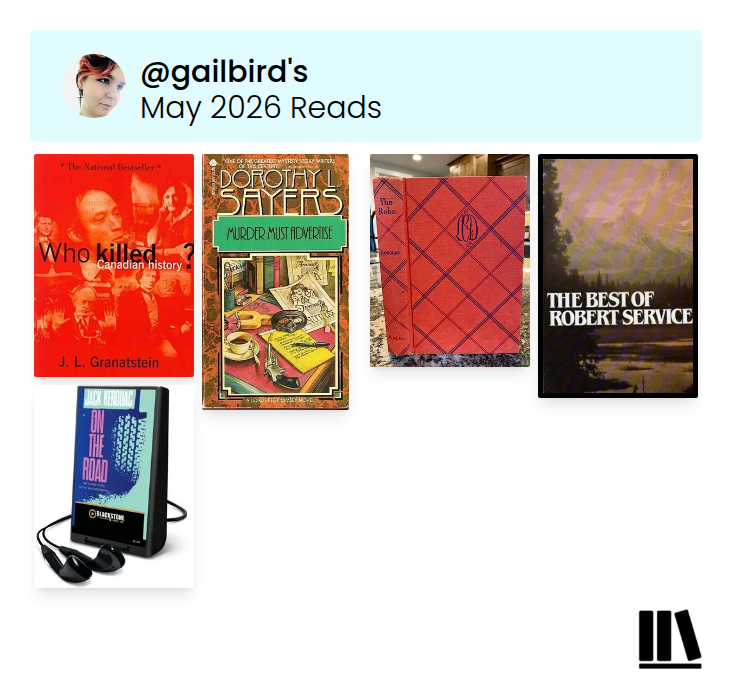
Who Killed Canadian History? J.L. Granatstein
Granatstein considers the state of Canadian history knowledge and education during the last half a century or so (this was published in 1998), and puts forward a case for revisiting why and how (or even if) history is being taught in Canadian schools. He critiques the topical/social approach that breaks the facts and chronology apart with no foundational understanding of historical development. (He would probably have a thing or two to say about the 100 Canadian Heroines book.)
While I don’t agree with every part of his perspective, this a passionately argued, short book with some good points of data about the decline in historical literacy and suggestions for closing the widening knowledge gap.
Murder Must Advertise, Dorothy L. Sayers
Lord Peter goes undercover after an unassuming ad-man dies mysteriously in his office building. Using his middle names, Death Bredon, as a cover, Lord Peter burns both ends of the candle writing smart, snappy ad copy for dairy products and vitamin companies from 9-5 on weekdays and following trails of drugs through the fever dreams of upper-class parties during the nights.
This is one of the most stand-out of the series I’ve read to date. There is so much great satire. Sayers really understands the ins and outs of the advertising industry, with a great observation of the characters involved with it. They were already sick of advertising copy in the 1930s, why do we still have to do it?
To be fair, I love the one-line hook for this book: “The New Copy Writer’s Name Was Death – His First Account Was Murder.”
The Robe, Lloyd C. Douglas
A dramatic biblical fiction imagining the character of the Roman centurion who was at the crucifixion of Jesus, this story takes us through the palaces of mad Roman emperors to the villas of the Herods in Palestine.
I’ve re-read this book multiple times and it has remained a favourite for years but this past read through I had a bit of a hard time with the pacing. I’m not sure I was in the right frame of mind to re-read it.
The Best of Robert Service
What a breath of clear, northern air after Dylan Thomas. Despite some popularity, especially with the verse ballads like “The Cremation of Sam McGee,” Robert Service may not be the most profound or respected poet, but he’s no less insightful for all that. There’s a plain, honest presentation to his language and he often hits on important ideas and experiences in a resonant way.
I enjoy the clarity and rhythm to his poetry. It’s understandable, accessible, and, despite his comparing himself to disadvantage with other more profound and respected poets, shows a love for poetry and its ability to express things beautifully.
On the Road, Jack Kerouac
The representative novel of the beat generation, this has been off and on different book lists of mine for over ten years. It’s a usual suspect on lists of must-read books and so found its way to my Classics Club list.
Last CC Spin, I was excited to finally get to it. So excited, I may have sabotaged my enjoyment of it because I got a digital audio verstion I could start right away instead of waiting for an inter-library loan. I reviewed it here.
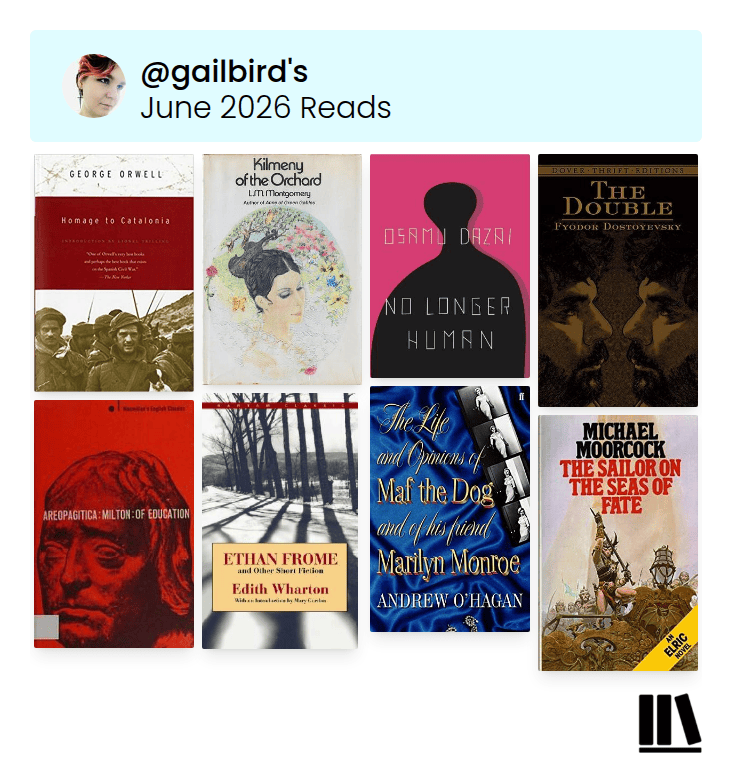
Homage to Catalonia, George Orwell
This is George Orwell’s memoir of his time in the militia during the Spanish Civil War, which, according to Orwell, is a deliberate propogandist misnomer; the conflict was meant to be a revolution but got sold out by its allies.
Orwell’s writing is engrossing and his account of weary, muddy, fleabitten months spent at various outposts with poor rations and worse weapons gives an undiluted picture of infantry warfare. He also gives an account of the politcal and reporting situations as they progressed both within Catalonia and internationally.
This is a Classics Club read so I will eventually write a more detailed review.
Kilmeny of the Orchard, L.M. Montgomery
A lovely little read about a magical summer meeting. I reviewed this in a recent post here.
No Longer Human, Osamu Dazai
Translated from Japanese, this short novel reminded me of nothing so much as Notes from Underground by Dostoevsky but whether that is a natural comparison or it was suggested to me by the preface, which compared it with the literary traditions including Dostoevsky, I’m not totally sure.
Suffice to say the tone of self-loathing and social misunderstanding and isolation is very familiar.
The Double, Fyodor Dostoevsky
After No Longer Human, I felt in the mood for Dostoevsky. The Double features a similarly socially hopeless case who constantly insists, to himself and others, that he is fine despite clearly spiralling. He meets a doppelganger who not only shares his name and his appearance, but slowly starts taking over his life.
As a Classics Club read, I will be writing a more detailed review of this as well.
Areopagitica & Of Education, John Milton
In my undergrad we read excerpts from Areopagitica and I absolutely loved it so I always wanted to read the entire thing. It is John Milton’s treatise against state censorship of books. He makes arguments considering the moral issues, the intellectual effects, and the overall futility of banning books.
The much shorter work, Of Education, is a somewhat idealistic vision of Milton’s “School for Gifted Youngsters.” Both give a vivid and inspiring picture of Milton’s passion for learning and high regard for its importance.
As another Classics Club read, a more detailed review is forthcoming.
Ethan Frome and Other Stories, Edith Wharton
I understand now. I get it. Ethan Frome is truly Edith Wharton’s masterpiece. With an intentionally insular atmosphere and limited cast of characters, this is a drama of gothic proportions. It is also a Classics Club read, which will entitle it to a longer review from me eventually.
The “other stories” in the edition I read also trend toward gothic, including ghosts, evil doppelgangers, and omens of future doom. I thoroughly enjoyed this other side of Wharton’s imagination.
The Life and Opinions of Maf the Dog and of His Friend Marilyn Monroe, Andrew O’Hagan
Narrated by Mafia Honey, the dog gifted to Marilyn Monroe by Frank Sinatra, this novel allows for some creative license as far as content and thought goes. Not to fear, Maf has picked up enough philosophical scraps throughout his life to carry a running commentary on everything and everyone crossing his path, from the young groupies to the stars, Natalie Wood, Peter Lawford, Dean Martin, and writers and playwrights, Carson McCullough, Truman Capote, and more.
After I got used to the tone of the writing, I enjoyed the experience of reading it, though there isn’t much eventful or even characteristic to grasp onto. It leans heavily toward the opinions of Maf the Dog, not so much of his friend, Marilyn Monroe.
The Sailor on the Seas of Fate, Michael Moorcock
Elric, self-exiled ruler of the oppressive and decaying empire of Melnibone, is driven out of a neighbouring kingdom by a band of xenophobic warriors only to be picked up on the shores of a misty sea by an enchanted ship and its blind captain. There, he is pulled into an interdimensional quest involving the eternal champions from across time and realms, of which he is one incarnation.
This is the second book of the Elric Saga (I haven’t read the first one yet) but I found it on a trip and unexpectedly had a lot of time to kill in the airport so I started with it. If only interdimensional ships picking up stranded travelers were a bit more common…
I was getting on the Classics Club reads during this quarter, apparently. Probably about the time I realised I only have a little over a year left to read almost half of my list.
In other news, I’m only on my second quarterly reading wrap-up and it has already become impracticable. Fourteen books of fiction, four non-fiction, two books of poetry: twenty books is too many to cover in one chunk. I think I’ll have to resign myself to monthly wrap-ups again, if I do anything.
 Fictitiously Yours
It’s a shame By Gaslight didn’t hold up to its promise. I love the cover. I have hopes of reading a Dickens this winter and have considered The Pickwick Papers. I’ve not read it before. I have that exact same edition of The Robe!
LikeLiked by 1 person
I heard about By Gaslight from people who had glowing reviews of it and though it wasn’t quite for me, I appreciate the atmosphere and ambition of it.
The Pickwick Papers is a great example of Dickens’ episodic writing and his ability to paint vivid characters. Might be a good winter read for you!
That’s funny because that edition of The Robe just happens to be what someone uploaded to The StoryGraph. It’s actually not the edition I own now, but it is the one I first read, which was my mom’s copy.
LikeLiked by 1 person
So glad you felt that way about Ethan Frome. I adore that book and will look out for your review of it.
LikeLiked by 2 people
I was totally absorbed in the story. Such a winter’s tale vibe to it! I don’t know how any review could do it justice, but I will try!
LikeLiked by 1 person
wow, some great titles here!
I like Osamu Dazai, but haven’t read this one yet
LikeLiked by 1 person