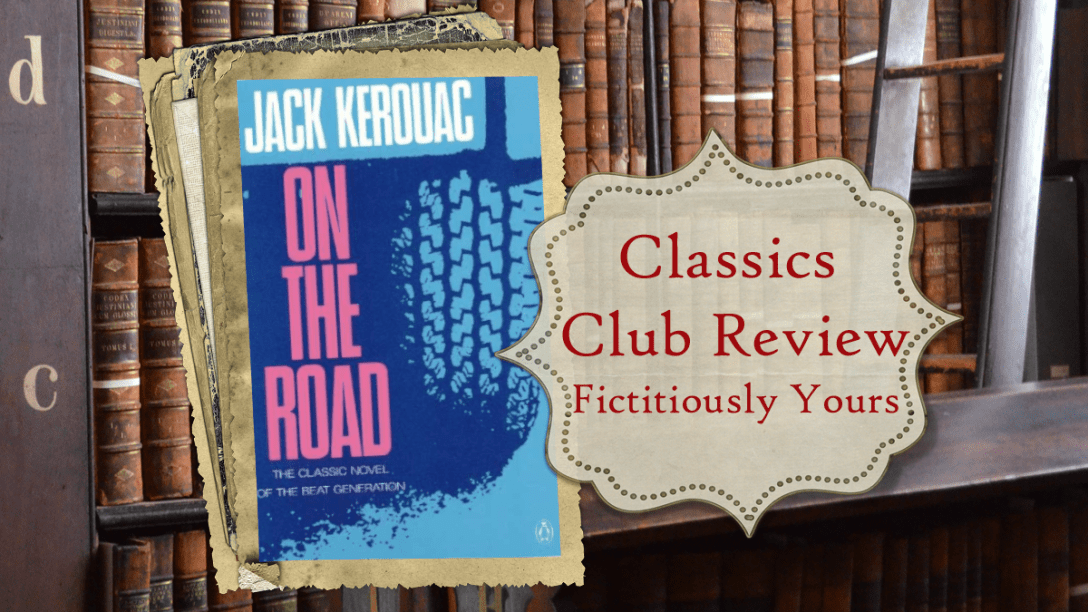
I listened to this on audio and that might not have been the best choice. Firstly, because I usually don’t find audio to be as good of a medium for my first encounter with a novel, but also because the narrator’s voice wasn’t exactly what I would prefer to listen to.
It wouldn’t have been quite so bad if he hadn’t also given the character of Dean the most annoying voice. I had to pause and reflect on whether I disliked Dean’s character just because of the voice or if it was him. I concluded it was mainly him. The inane things he said could not be improved much by a more pleasing narrator. The amount of times he just strung filler words together like, “wow,” and “yes,” and “man!” was grating.
Much of the story is summary of people the narrator, Sal, meets on various road trips. There is a sense of constant motion and back and forth. The most interesting character moments to me are in the beginning of the novel when Sal is hitchhiking by himself.
And when Dean reappears and keeps popping into Sal’s life and dragging him out for rambles, I found myself wondering what the point was. But the motion is the point.
This novel is about directionlessness. The way the post-war years and the abundance of opportunity actually left some people more confused about where to go or what to do or what the meaning of it all was. Dean in particular becomes a concentrated ball of life-force, wound up with nowhere to go. So he drives fast, has sex, and burns with all the pent-up potential that could have meant something to someone beyond himself.
I relate to the way Sal gets the travel bug every once in a while and just has to move, to go somewhere, see something else. I also, to a lesser degree, get his fascination with the personality of someone like Dean. He’s awful, pretentious, selfish, destructive (of himself and others), and promiscuous.
(Also, the way Dean is described is insufferable. While reading, I wrote in my notes: “If I have to read about him hopping around like a demented jackrabbit and rubbing his belly one more time…”)
He’s rather directly, yet accurately described as mad, which probably encompasses the root of it. He’s too bright, too alive, too explosive.
[T]he only people for me are the mad ones, the ones who are mad to live, mad to talk, mad to be saved, desirous of everything at the same time, the ones who… burn, burn, burn like fabulous yellow roman candles exploding.
Jack Kerouac, On the Road
One of the most poignant moments is when Sal’s and Dean’s friends meet up later, having married and/or settled somewhat (though they somehow continue to drink and do drugs fairly casually), and they start losing their rose-coloured glasses of Dean who has never seemingly changed or matured. They start to scorn him, ridicule him, and even though it’s not misplaced, it is in a rather self-righteous spirit that makes you feel for Dean. They aren’t any better, not really, they’re just pretending better than he can.
Sal doesn’t ever look down on him in this way, however honest and unflinching he is in describing Dean’s decline and ultimate wreckage. I think it’s Sal’s words that save Dean, and this book, for me. Words I couldn’t fully pause and appreciate while listening to the audio, because it just continues, and I had my hands in dishwater or something equally inconveniencing.
Overall, even taking into account the disadvantage of the medium, this book isn’t a favourite of mine. Still, it is something I would revisit, in print form, just to be in the climate Sal creates of travelling through life in mid-century America. It has a beautiful beating heart that is at once nostalgia and possibility.
This has been my twenty-fifth Classics Club book review! Check out the rest of my list here.


[…] On the Road (1957) by Jack Kerouac […]
LikeLike
I’ve never read this and it’s one of those books I’ve always felt I should have – the American classic novel of the Beat Generation. A bit before my time (but not by much), I’ve always wondered if I could appreciate it.
As I found with the last book I reviewed, audio can make or break a book. It’s my favorite way to read a Christie, but I might prefer to try this in print.
LikeLike
I see how much of a representation it is of that time and the feelings that were running high in the younger people. Though, yes, you might want to read it in print if you do get to it.
Funny how different books seem to better translate to different mediums! I’ve also listened to an Agatha Christie book for the first time and didn’t think that not having read it in print first was any detriment to it. It was also a very good production, I thought, with a talented narrator. I must look for more audiobooks of hers!
LikeLiked by 1 person
I’ve stuck with Hugh Fraser narrations for the Poirots with the exception of one read by David Suchet.
LikeLike
I will have to look up the Poirots with Hugh Fraser! The one I enjoyed is “N or M,” narrated by James Warwick.
LikeLiked by 1 person
[…] Last CC Spin, I was excited to finally get to it. So excited, I may have sabotaged my enjoyment of it because I got a digital audio verstion I could start right away instead of waiting for an inter-library loan. I reviewed it here. […]
LikeLike