
Last year I was inspired by a PewDiePie video challenging himself and his followers to read a selection of philosophical works over 2025. They were all books he had read before and stayed with him. In his video, he gives a brief overview of each book, as well as what he found valuable about reading it and why he thought it was worth revisiting. Many of the titles were famous ones I always thought I might get to, someday.
Why not now?
While I shied away from actually, officially joining the bookclub, due to a little problem I have with demand avoidance, I tried to follow along and read the books on the suggested timeline. I even found someone created the Challenge on the StoryGraph, which I joined.
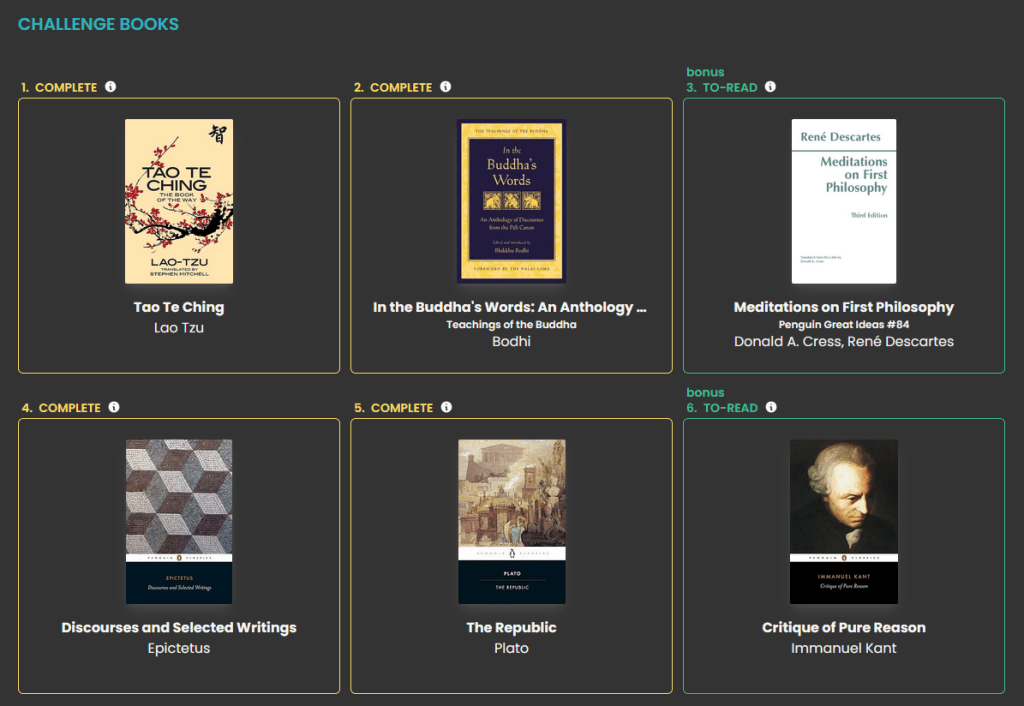
1. Tao Te Ching, Lao Tzu
Despite not knowing much about Taoism, I definitely encountered familiar ideas in this short collection of wisdom teachings. Many of its little epigrams such as
Those who talk do not know;
those who know do not talk
and
the wise may grasp the present,
because they understand the past
have survived in the collective consciousness in various forms.
It is reminiscent of a book of proverbs and identifies its philosophy or teaching as “the Way.” Not to be confused with the Way of the Mandalorian, or the Way of Rev Bem in Andromeda, though, naturally, there are some obvious influences.
I enjoyed the read, which is brief, pithy and understandable. There are some mystical references to the Tao and the Source, and of course yin, yang, and chi, but regardless of beliefs, the overall the matter articulated about life, humanity, and the existence of spirituality is insightful and thought-provoking.
2. In the Buddha’s Words
This is a doorstopper of an anthology of the Buddha’s teachings. A scholarly edition, it also includes clarifications about sources, brief histories, and content summaries. Wanting to get as much context and understanding for it as I could, I read all these additional materials thoroughly.
It made me want nothing so much as to watch the three books of Avatar: The Last Airbender from start to finish instead.
Because, of course, ATLA’s world of benders and avatars is lifted from Buddhism, which I knew, but also became more obvious the more I read. Not that the show is subtle about it. The Avatar as a position and the Avatar State (“Yip! Yip!”) are a fantasy reimagining of the acension of the Buddha and the achievement of Nirvana.
But to keep on the topic (because I didn’t go watch ATLA instead), there is an oral knowledge aspect to the writing, which means repetition and patterns. Great for recitation, kind of mind-numbing to read. And this edition omits many of the repetitive phrases/constructions for the sake of brevity.
On the content side, Buddhism is often portrayed as this kind of zen, flowstate, and there is an element of that, certainly. It encourages internal reflection and detachment from excessive physical sensation that would distract a person from spiritual matters. All to the good.
But I found a kind of disconcerting emphasis on absenting oneself from all desire, including seeming virtuous desires like nurturing family, community, and creativity. The argument is that if you have no desire, you cannot be affected or pained by it not being met. It strikes me as pretty inhuman.
Which is probably the point–because Buddhism is about transcending humanity to virtual godhood and exiting the reincarnation cycle by following the eightfold path.
Overall, I just didn’t feel that this read had much value for its volume compared to the (very much) shorter Tao Te Ching. It gave me a better understanding of Buddhism, but contained much less relevant wisdom to me because I don’t subscribe to the whole faith’s model.
3. Discourses and Selected Writings, Epictetus
In PewDiePie’s video, which I revisited before writing this post, he said if he had to pick one book out of all of these for everyone to read, this would be it.
I have to agree.
It is far and away my favourite of the list. Epictetus has a way of getting to the root of life’s concerns and breaking them down for common understanding. He’s also at times quite sarcastic and hilariously reduces things to their most obvious. I found myself continually stopping to take note of a quote or sentiment that made me think about something in a new way.
It’s also incredibly practical. He is not a sophist who simply talks about things as if talking was the end goal, or discusses ideas as though discussion was the end goal. His philosophy is for life and living. It is a way of reframing your thinking so that your actions will follow according to those improved ideas.
His contention mainly is that your life experience is determined by your will and impressions. Who has control over your will and impressions? Hopefully, you claim that role, because if not, you are at the mercy of circumstance and other people. If you do claim ownership, you will realise how free you are to feel and act.
What frightens most people and keeps them subdued? It can’t be the tyrant and his bodyguards; what nature has made free can only be disturbed or hampered by itself. A person’s own thoughts unnerve them.
Epictetus, Discourses and Selected Writings
Additionally, your will and impressions are about all you have control over, which means everything outside of that is not yours. You can’t control other people’s wills or impressions and you will be miserable if you try. Let go of what is not yours to carry, essentially. Take responsibility for yourself, and let others do the same for themselves.
Trustworthiness is your own, decency and a sense of shame; no one can take them from you or prevent you from using these qualities except yourself–which you do the moment you begin to care about what is not yours, surrendering what is yours in the process.
Epictetus, Discourses and Selected Writings
There is so much more to be said about Epictetus. I can’t possibly go into it all to do it enough justice. There are practical things about many issues, including possessions, public office, being a good companion when in company and content when alone, and keeping your own counsel.
This is the closest to a user manual for the human consciousness that I’ve ever seen.
4. The Republic, Plato
Not far into my undergrad as an English major, I realised a prior reading list of influential works that are referenced throughout literary history would have been helpful. The Bible would be on it, of course, one of the few I was already familiar with. Another was Plato’s Republic, which came up in reference to Thomas More’s Utopia, in part an answer to or a lampooning of Plato’s ideas. I don’t think our class precisely decided which. It may have been a combination of both.
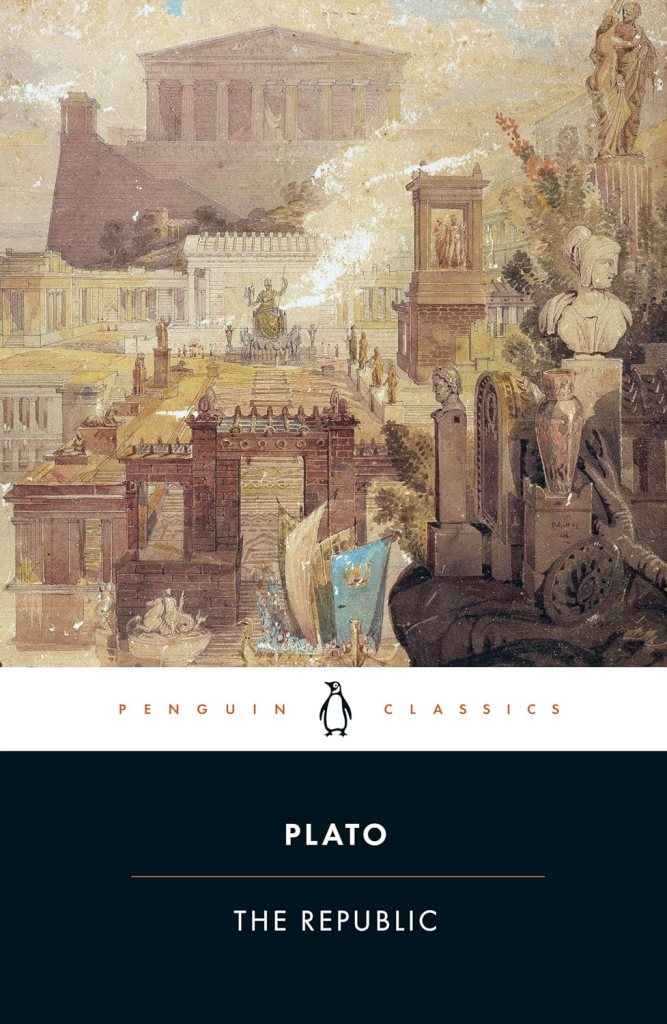
Ever since, The Republic has cropped up and been a sort of an aspirational entry on my to-read list. Alas, if I’d only had a classical education! So when it came up on this challenge, I decided there was no time like the present.
I was surprised to find the format of this famous work of Plato’s is actually an imagined dialogue he puts in the mouth of Socrates. Initially, the goal is to figure out what makes justice and virtue justice and virtue. Convention? Consequence? Something else? Attempting to answer this to everyone’s satisfaction, Socrates forwards the idea that the good of an individual cannot be severed from the good of society, and vice versa, a good society makes for good citizens.
Thereby, an ideal man will be a smaller pattern for an ideal society. So he starts drawing out what such a society, and therefore a man, will be like.
Here is the basis for probably a dozen fantasy worlds’ hierarchies, and the influence for probably more than a hundred modern dystopias in various ways.
Socrates insists on classes of citizens, each doing something purposeful to contribute. This is also where the idea of the philosopher-king comes in. He has outlines for education, vocation, and gender roles. He compares and contrasts all types of societies from oligarchies to tyrannies and expounds how the character of individuals tend to contribute to and react under each.
It’s a dizzying range of topics, given that it is a large consideration, an entire society. It gets even more complex considering it is also meant to reflect the makeup of an individual: there is a reason it’s called the body politic.
Despite knowing of its influence on literature, I didn’t realize there are so many familiar ideas in our society and popular consciousness that originated from it. It will be something I need to brush up on occasionally to absorb more.
For now, one of the more memorable moments to me is the simple characterization of dogs as philosophers.
‘[The dog] is annoyed when it sees a stranger, even though he had done it no harm: but it welcomes anyone it knows, even though it has never had a kindness from him. Haven’t you ever thought how remarkable this is?’
‘I can’t say I ever thought about it before,’ he replied. ‘But of course it’s what a dog does.’
‘And yet it is a trait that shows discrimination and a truly philosophic nature,’ I said.
Plato, The Republic
It made me think of Thomas Hardy, when he glibly says, after Gabriel Oake’s young herding dog destroys his herd of sheep, and thereby his farm, by running them over a cliff into a bog:
[The herd dog] had done his work so thoroughly that he was considered too good a workman to live, and was, in fact, taken and tragically shot at twelve o’clock that same day—another instance of the untoward fate which so often attends dogs and other philosophers who follow out a train of reasoning to its logical conclusion, and attempt perfectly consistent conduct in a world made up so largely of compromise.
Thomas Hardy, Far From the Madding Crowd
Hardy must have read Plato, I’ve no doubt.
And that’s part 1 of my PewDiePie Book Review 2025! Stay tuned for part 2, and the last three (or four) books on the list.
 Fictitiously Yours
I’ve always struggled with philosophy, so this would be difficult for me! Of those listed here, I think I’d be most interested in reading Plato’s Republic and The Teachings of Buddha. I do have Utopia on my new Classics Club list, so we’ll see how that goes.
LikeLiked by 1 person
Philosophy can definitely feel overwhelming, but there are always accessible places to start! Like Utopia being an adventure/travel narrative that also deals with philsophical ideas.
And while I thought it would have been nice to have read The Republic first, even if you don’t, you can always do a bit of contextual research and get the gist of the references. It may surprise you how many of the ideas you’re already familiar with as it did me!
LikeLiked by 1 person
They all sound interesting but I’m drawn to Epictetus. Was it hard going?
LikeLiked by 2 people
Not at all! I found Epictetus to be one of the most straightforward to read. It’s also broken into quite manageable sections or topics so it’s easy to dip in and out without losing the plot.
LikeLiked by 1 person
That’s encouraging. Thank you.
LikeLiked by 1 person