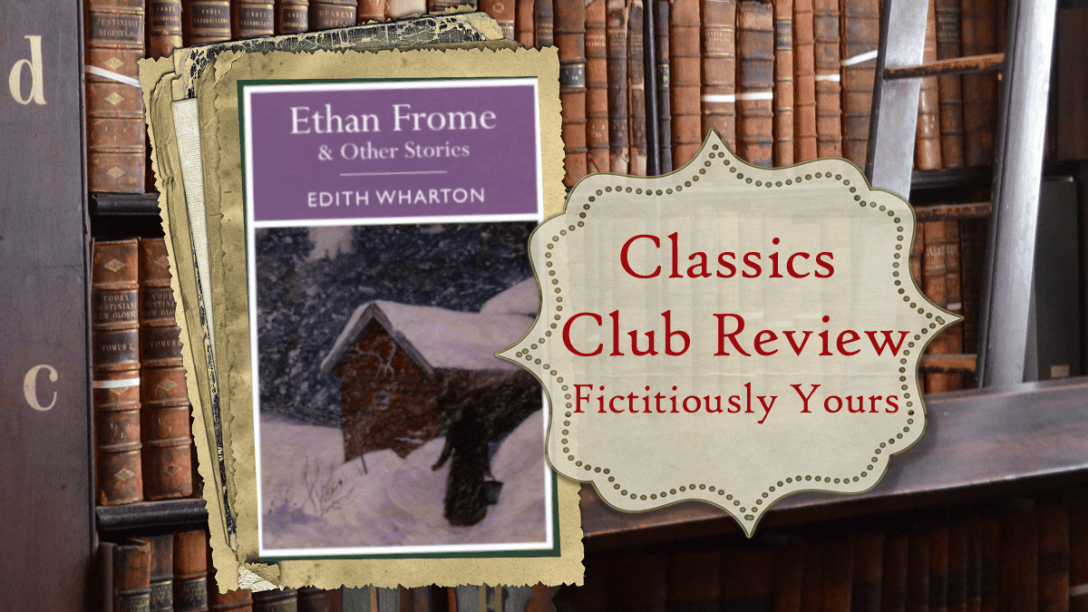
Ethan Frome, Edith Wharton
When the narrator arrives in town on business, he observes the character of Ethan Frome. There’s a story there, as Ethan walks crookedly due to a serious injury which was caused by what is colloquially referred to as “the smash-up” almost twenty-five years before. Despite a promising youth, he is now tied to a poorly producing farm and an invalid wife. They never have any visitors anymore, and Ethan comes alone into town for their mail and supplies.
Curious, the narrator hears a couple versions of Ethan’s history from various townspeople, including coach driver Harmon Gow, before a winter storm leaves the narrator stranded and Ethan invites him to take shelter at his farm.
Though Harmon Gow developed the tale as far as his mental and moral reach permitted there were perceptible gaps between his facts, and I had the sense that the deeper meaning of the story was in the gaps.
Edith Wharton, Ethan Frome
The real story of Ethan Frome slips in between the narrator’s arrival at and entrance into the reclusive man’s home. Something the narrator sees gives him the key to all the allusions and implications, and he is able to reconstruct the tale that started over twenty-five years prior.
This is a departure from what I have read of Wharton before. Not here the urbane dynamics of power and influence, wealth and family status, such as is found in The Age of Innocence or even The Glimpses of the Moon.
Instead, Ethan Frome is set in a bleak New England town, isolated and insulated from the wider world. Its catalyst is the arrival of a stranger both in the framing of the story with the businessman narrator as well as in the real story of Ethan Frome himself with the arrival of Ethan’s wife’s cousin.
It begins and ends with Ethan Frome in the same place, yet the story has taken us on a harrowing inner journey. Nor is Ethan unmarked by the experience, physically or mentally.
Edith Wharton is a master of subtlety and complex character construction and I think she proves it with this novella. There is no circuit of visits and dinner parties, no cruises or extensive travels that might give interest to a shallow character or artificial drama to a relationship. Instead, she sets a closed stage within the shadow of massive granite formations under the lowering ceiling of a winter storm and lets the cast spark with friction.
I read it in the height of summer and even I felt a chill snaking my stomach as I compulsively turned these pages–a chill only partially relating to actual temperature and more in reaction to the realisations I was coming to about the characters. There is a way in which being a martyr actually oppresses others. Also, if there is a horror in loneliness, there is an equal potential for horror in being perpetually bound to certain people.
It would be a perfect read for the dark evenings this time of year.
& Other Stories, Edith Wharton
Four stories of the supernatural were also included in the edition, featuring such old favorites as phantom hounds, eyes that reflect a person’s own deteriorating soul, an untimely ghost, and an evil doppelgänger.
I have to say, it’s hard to follow up Ethan Frome, even for the author herself (not that the stories literally followed EF in publication, I’m just using it in a more general sense). While the writing and characterisations are strong as ever, the overall interest of the stories was not so much in their novelty.
I think my favourite was probably “The Triumph of Night,” which coincidentally features a similar sort of atmosphere and device as Ethan Frome–on a winter night, a traveller is invited to stay with a stranger. “If on a winter’s night a traveler…”
There the similarities end, though.
Perhaps I would have enjoyed the other stories more overall if I hadn’t been a traveller myself while reading them, interminably delayed in a liminal terminal.
This has been my twenty-eighth Classics Club book review! Check out the rest of my list here.


[…] Ethan Frome (1911) by Edith Wharton […]
LikeLike
This sounds good and I might put it on my list for RIP season next fall. I’ve yet to read anything by Edith Wharton, but have The House of Mirth on my spin list this time.
LikeLiked by 1 person
I really enjoyed your review, Gail. I’m a big fan of Edith Wharton and particularly of Ethan Frome, so appreciated your insight and the depth of this review.
Im intrigued by the idea of the story being told from Zenobia’s point of view (I can be a broken record on the subject!) and wish someone would write it!
I haven’t read any of her supernatural short stories yet but will eventually. The supernatural must have been a fad at the time; authors wrote about odd events and readers lapped the stories up!
LikeLike