Last year I was inspired by a video PewDiePie made challenging himself and his followers to read a selection of philosophical works over 2025.
I reviewed the first four books of the list in a post here. This is the rest of the list.
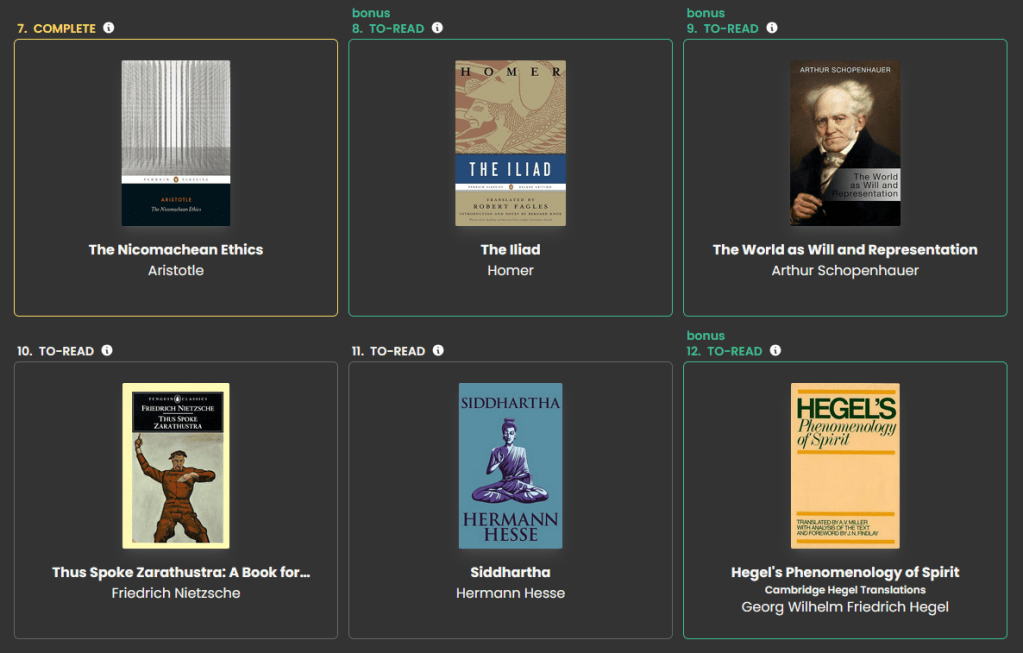
5. The Nicomachean Ethics, Aristotle
“Everything in moderation.”
I’ve been hearing this Aristotelian philosophy my entire life.
From whom? you might ask.
My mom.
Which is somewhat fitting, because Aristotle is thought to have gotten these ethics from his father, Nicomachus. Turns out, it’s Biblical: “Let your moderation be known unto all men. The Lord is at hand” (Philippians 4:5). And it is also found in the Tao: “The wise respect the roles of all, / and seek moderation in all things” (29 Power).
In his consideration of ethics, virtue, justice, and happiness, Aristotle works through many qualities and demonstrates how excess and lack in any miss the mark. It’s an interesting approach that helps clarify the dilemma around right and wrong as well as moral responsibility.
He always turns logic to his purpose, which is as convincing as it is at times confusing. If A is this, then B is that, etc. Though a dense read (probably the most challenging to follow and comprehend out of this list, for me), it is correspondingly deep and is something that, like Plato’s Republic, I will definitely have to revisit.
6. Thus Spoke Zarathustra, Friederich Nietzsche
This is a poetic and fevered whirlwind of topics and ideas put forth by a prophet in the wilderness, encountering kings, madmen, and donkeys (some of them several at once). It is a fabled account of a philosopher and his struggle with existence, society, and the self.
Was this the best book to be introduced to Nietzsche? Perhaps not. I have a passing familiarity with some of his ideas, including of course the übermensch and the will to power, which he references in this book, but even much of that knowledge comes second hand through media (such as the highly dubious representation in Gene Roddenberry’s Andromeda).
Perhaps it is just me seeing patterns, but there are echoes of Epictetus and Aristotle in this as well: “Open still remaineth a free life for great souls. Verily, he who possesseth little is so much the less possessed: blessed be moderate poverty!”
I was somewhat dizzied by the array of ideas, but it is an interesting commentary on society, human nature, religion, and life in a highly stylized narrative.

Alas, to my shame, I did not complete this before the end of 2025.
7. Siddhartha, Herman Hesse
This short novel follows the title character as he leaves his family and their expectations to pursue his own enlightenment. Initially, a friend accompanies him, but when they stop at a monastery, the friend decides to stay while Siddhartha pushes on. Dialogues with the Buddha fail to dissuade him from going out into the world and experiencing physical pleasures.
Through it all, Siddhartha realises the transience of life and its attendant importance. He maintains a Buddhist perspective of the cyclical interconnectivity of all things and ultimately leaves the life of self-indulgence to find enlightenment on his own terms.
It was a different take on the Buddha and the story had its interesting developments, but overall I didn’t find it that compelling. Perhaps that is partly to blame for why I also didn’t finish this one before 2025 rang out.
I did enjoy some of the writing, and still have Steppenwolf on my Classics Club list, so I will give Hesse another chance eventually.
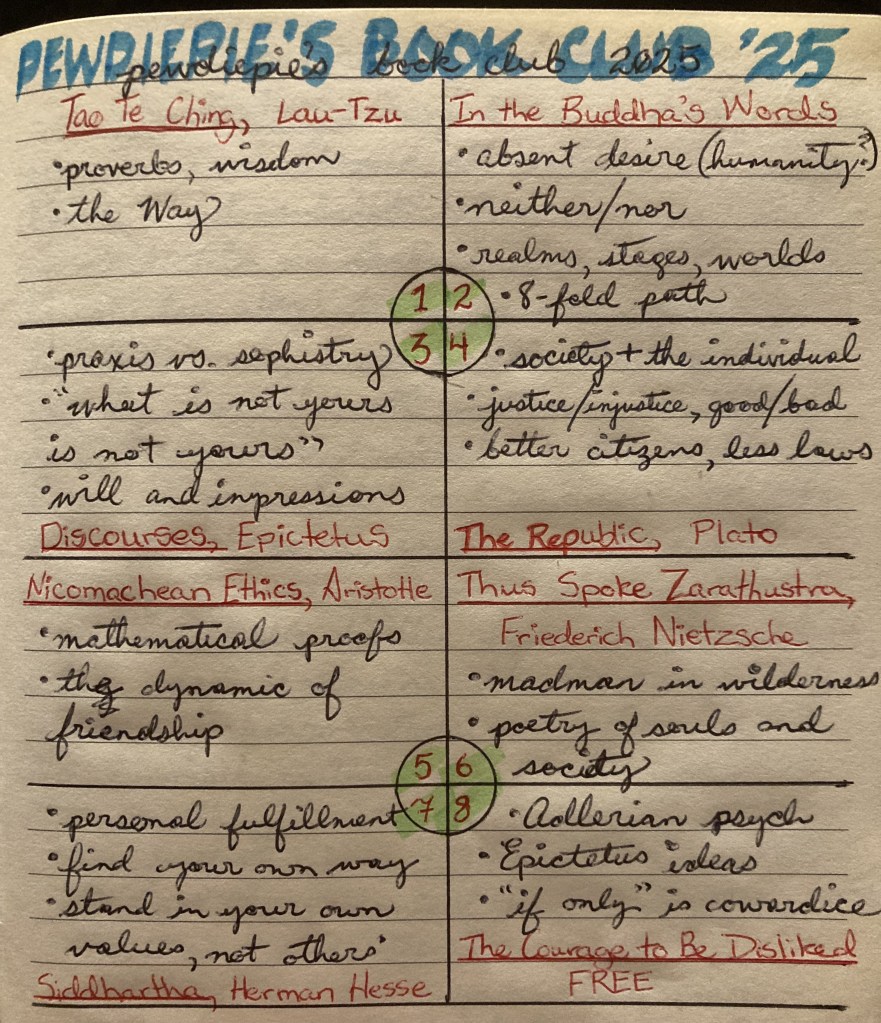
8. Bonus Book: The Courage to be Disliked, Ichiro Kishimi and Fumitake Koga
As bonus books were suggested but ultimately your own choice, I decided to count a book I had read early in the year on my own: The Courage to Be Disliked by Ichiro Kishimi and Fumitake Koga.
While it draws on Alfred Adler’s theories of psychology, I found direct connections to the concepts articulated by Epictetus. Adler must have been conversant with The Manual.
Rather than a traditional Freudian approach of what happened in your past or childhood being the key to the present, Adler, as related in The Courage to Be Disliked, contends that what happened in your past is not in your control and therefore should not be looked to as the determiner your life: you should be.
Let go of what is not yours. Carry what is your responsibility: your choices now. (Not the future, either: just now.)
Neither The Courage to Be Disliked nor Epictetus try to deny the effect of events and people’s actions on us, they simply reject submitting to the conclusion that we are powerless to change or are irrevocably damaged. When we stop trying to manage things outside our realm of control, including our past and other people’s perception of us, we can focus on what is in our power.
In the style of a dialogue, I enjoyed reading this as a simple and accessible way to reframe thoughts about life and taking agency within it. It was neat to read this shortly before Epictetus and see how the ideas dovetail.
Conclusion
While I didn’t complete all the books in the allotted time (hence the incompleteness of my graph), I did read them. Which is more than I would have done otherwise, so that’s a win.

As Epictetus says,
Even if I lack the talent, I will not abandon the effort on that account…In short, we do not abandon any discipline for despair of ever being the best in it.
Epictetus, Discourses and Selected Writings
Or, perhaps to end with a word from the mad philosopher-poet:
Ye higher men here, have ye not all–been failures?
Be of good cheer; what doth it matter? How much is still possible! Learn to laugh at yourselves, as ye ought to laugh!
Friedrich Nietzsche, Thus Spoke Zarathustra


I find this group a bit more intimidating than those in your earlier post. Books like these are very much outside of my comfort zone! Kudos to you for reading them!
LikeLiked by 1 person
It was a good exercise to have a reason to read things I wouldn’t have necessarily picked for myself but I was definitely losing a bit of steam there at the end!
LikeLiked by 1 person