
Recently I found myself in a store aisle asking, Should I buy this canvas sign with black type on a white background stating “Do More With Less”?
I was tempted. It was marked down. The lure of a deal sang its siren song.
But the answer was, unsurprisingly, No. The existence of the sign is an oxymoron. Buying it would contradict its message.
That I even considered it made me realise how deeply the consumer mindset runs.
We rationalize how getting more will help us end up with less. More storage space, more organizers, more containers…
Somehow, we never want to accept the fact that the key to having less stuff is actually having less stuff.
I’ve been working through the 30-day decluttering challenge over the last month and I’ve realized our relationship with our stuff is determined by the story we tell ourselves about it.
As long as the story serves you well, its fictitious nature should not be a detraction. But it should always be subject to re-evaluation. What about when it becomes a hindrance?
I encountered one of those unhelpful fictions looking at the “Do More With Less” sign. The story was that a deal justifies an unnecessary purchase.
It was pretty simple to see through as no longer helpful for my narrative, but they’re not all that easy.
Here are some principles I’ve found to help rein in an out-of-control narrative surrounding my stuff.
1. “Enough is as good as a feast.”
I again stood in the store. I had assessed a gap in my kitchen supplies for a food storage container with the following features:
- Size, large.
- Quality, good (i.e. not cheap plastic).
- Quantity, one.
I only saw one or two options with all the required characteristics. Easy choice.
But what is that on yonder shelf? A set of three containers, for almost the same price as I would be paying for this other one container.
I could get more, for less!
But I came for one. I already had containers of the other sizes and these weren’t the quality I decided to invest in.
I almost talked myself into something I didn’t want and wouldn’t be happy with. There was a false narrative that it would be frugal to buy more, when in fact it would lead to excess.
Upon some honest reflection, I had already found exactly what fit the need.
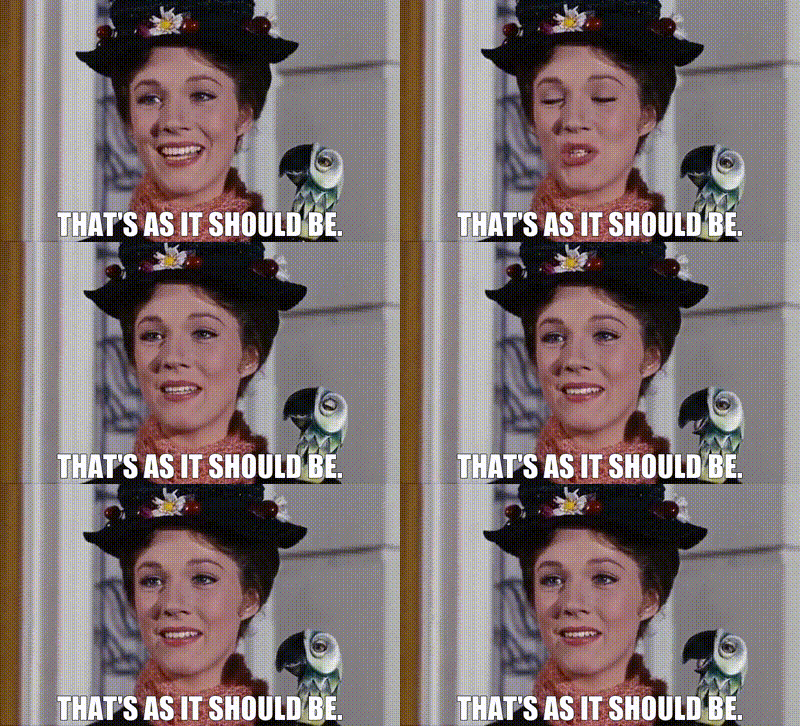
As Mary Poppins said, “Enough is as good as a feast.” A much better story than false frugality.
2. If you don’t know what to do with it, you actually do.
How often do we keep stuff just because we don’t know what to do with it? *raises my own hand*
It’s not something we want, need, or have a use for. It’s the random accessory that smuggles itself in with the gadget, the plastic stopper dohickey on the lotion pump bottle, the velvet drawstring bag that some earring backs came in, even generally useful things that you don’t personally use: spare containers, spare parts, spare whatever.
These turn into a vast constellations of useless objects scattered around our spaces.
The story we tell ourselves is that we might need it someday.
Are you keeping twenty empty tomato sauce jars because they could have a use for someone or because they do have a use for you? It’s time to root out the conditional words (could, might, etc.) that populate this particular story.
Scarcity mindset needs to be reined in or else it is actually hampering the ability to live your life. It can lead to dozens, even hundreds of extra items to care for, clean, and upkeep, in addition to the storage space and mental energy their presence consumes.
By all means, try to make use of things you already have. But if you’re standing around looking for a function for something to justify keeping it, that’s a waste of your time, my time, and our great-grandchildren’s time.
In case the implication of the heading to this section wasn’t clear, not knowing what to do with something should be what tells you to get rid of it.
I practice asking, What’s the worst that could happen if I didn’t have this and couldn’t get it again?
For most things, momentary inconvenience, if that. Not a very compelling story.
3. Usefulness needs to be re-evaluated.
So you’ve found uses for some things–you always used that bag, that box, that hair accessory. Maybe for years it’s been in constant rotation, your go-to, a fixture of your routines.
But then you started a different routine, changed some habits, started using different things more. And suddenly, your well-liked and well-used whatever-it-is sits on the shelf longer and longer between uses.
Eventually, you don’t pick it up at all. But strangely it maintains the aura of being in-use. This is the fiction of usefulness we tell ourselves about items that the story is already over for.
It happened to me when looking around for potential tributes for one day’s decluttering quota. My eyes landed on a spare hairbrush I hadn’t used in months but my mind tagged it immediately, without hesitation, as “Useful.” Data supporting: I used to use it almost every day for years.
It was admittedly the pressure to get rid of more items that motivated me to stop and re-examine this conclusion. That something used to be useful, doesn’t mean it is now. And if it’s not useful now, it can be safely gotten rid of. It doesn’t make its usefulness in the past any less real because it has now ceased.
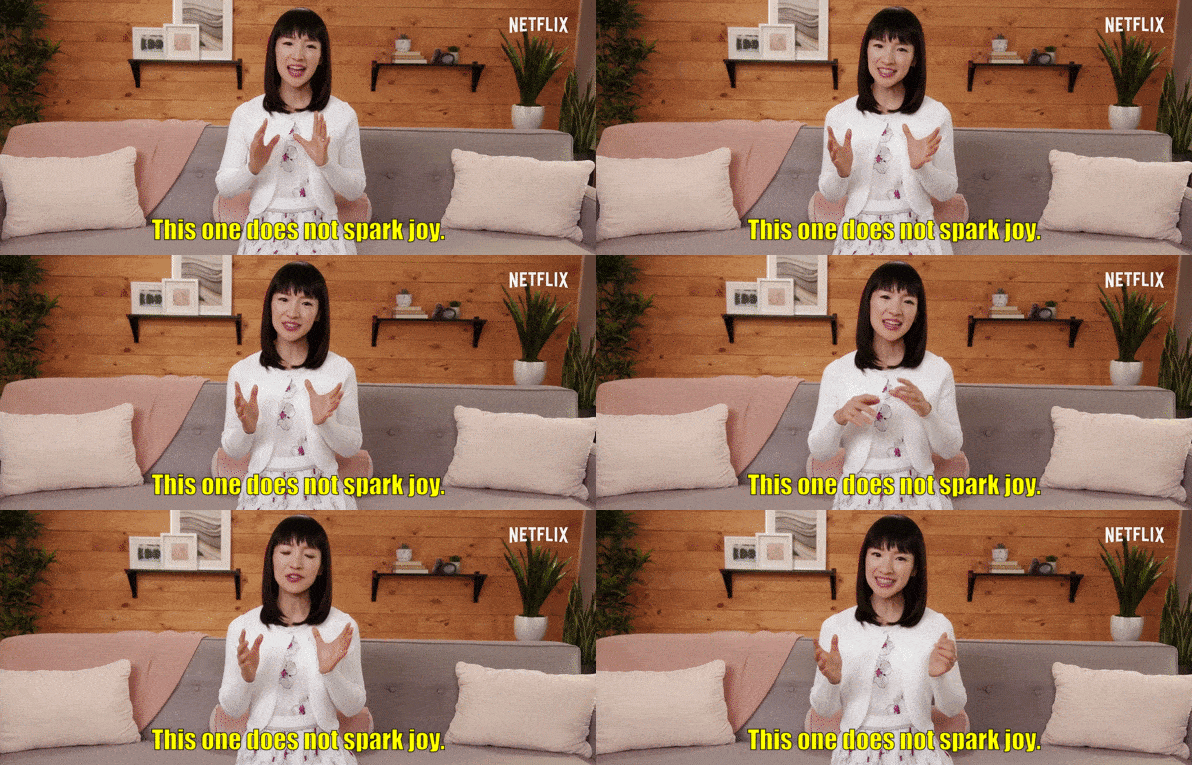
This is a good place to apply the Marie Kondo, “Thank you for your service,” and pass it along. Give that item’s story in your life the ending it deserves.
4. If it’s too junky to donate, it’s too junky to keep.
So we’ve rounded up the offending odds and ends, we’ve recategorized the “used to be” useful items. Things that can be re-used and repurposed are easy enough to donate.
But what about the random plastic lotion-pump-stopper? The ratty, tatty tissue paper? A thrift store can’t resell those–they have no universal purpose, no inherent value.
So what do we do? We store it.
It sits in limbo in our minds, posing a question as to what to do with it, never presenting an answer. Unfortunately, our houses don’t have unlimited space to be designated “limbo.” These pesky baubles find their ways to drawers, surfaces, cupboards, and crannies.
Sometimes we also hang on to things that broke down and were replaced, because maybe it has usable parts or could be repurposed. The story is “waste not.”
I’m all for repairing things that break down if it’s reasonable and achievable to do so. I recently “fixed” a Blu-Ray player by doing a simple lens cleaning I learned from YouTube. It feels great to give more life to something when you can.
But are you really going to refinish that old battered, drawn-on nightstand that you’ve been tripping over for the past ten months?
(And maybe you, reading this, are exactly the person to flip furniture and have a grand old time sanding, staining, or repainting pieces. If so, the example may not be for you, but perhaps you can apply the principle to other things.)
If not, maybe you (and I) need to stop telling the story about refurbishing or repurposing the item that’s been sitting around forever. It’s not useful to tell ourselves that we’re being non-wasteful if in fact we’re wasting our space and energy having to think about and decide against actually fixing that piece of junk for the eighteenth time this month.
Ideally, we should be limiting intake so things don’t pile up at all. But they sneak in regardless and at some point you have to put a limit on the crap you keep because the inevitable result of keeping these junk items out of the landfills is that your home becomes the landfill.
We need to rethink our definition of waste, not extending it to every item that passes through our hands/door and ends up in the trash, and realise there are other kinds of waste: what about wasting our time, energy, space?
We may need to reconcile ourselves to garbaging some things for the sake of the sanctity of our home. I don’t have unlimited stores of energy and time to give to junk, so it’s not a waste to throw it away.
In my story, it’s actually conserving the most important, irreplacable resources I have.
In addition to my little declutter challenge, I’ve been reading some philosophical works recently and Epictetus has this to say of worldly possessions and attachments,
Don’t tell yourself that they’re indispensable and they aren’t.
Those are the reflections you should recur to morning and night. Start with things that are least valuable and most liable to be lost–things such as a jug or glass–and proceed to apply the same ideas to clothes, pets, livestock, property… Look on every side and mentally discard them… this is the genuine freedom you cultivate.
Epictetus, Discourses and Selected Writings
The moment I realised the effectiveness of decluttering and maintaining my things traced back to the narrative I told myself about them, I was able to slowly shift those assumptions and see progress in the direction I wanted to go. I’m still working on it but it’s far easier to manage and actually let go of things now than before.
What stories do you find yourself telling about your things?
 Fictitiously Yours
What an excellent post! You’ve made some very good points. I need to do a good purge at my house. I’ve had to help clean out more than one relative’s home after their death so I know what a chore that can be. Besides, I’m not getting any younger…
LikeLike
I’m glad you found it useful! It is certainly easy to see when other people’s stuff gets out of hand–sometimes less so with our own. I hope your declutter/purge goes well and you have some new ideas to help motivate you!
LikeLiked by 1 person