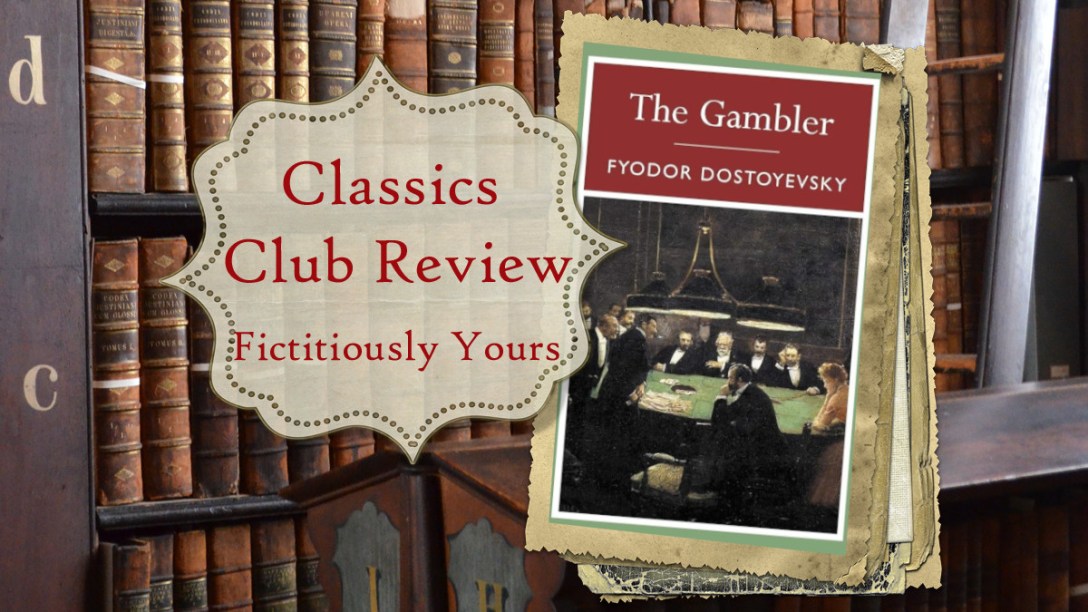
By all accounts, Dostoevsky wrote The Gambler on a deadline, ironically, to pay gambling debts. No better way to prove invention’s parentage is necessity. I recently missed another Classics Club spin, only to realise I still haven’t performed the function of reviewing my last Classics Club read for Spin #39. Hence the necessity of my invention here today.
To-day has been an absurd, grotesque, ridiculous day. Now it is eleven o’clock at night. I am sitting in my little cupboard of a room, recalling it.
Fyodor Dostoevsky, The Gambler
I had a weird time reading The Gambler. I started off listening to a LibriVox recording of it. Then, partway through I acquired a physical copy. So I started reading from the point I’d stopped listening. Then I alternated with an audio chapter before bed here, read a chapter over supper there, until I ended so hopelessly out of the flow that I decided I needed to re-read the whole thing before I could attempt a review.
Which I did, in the beginning of December. And then didn’t write a review anyway. The book was read twice, reviewed nonce.
Until today. Three months and a new year later.
The Gambler is another wonderful exploration into the vicissitudes of human characters, relationships, and obsessions. The mercenary awaiting of the wealthy grandmother to die for an inheritance, the supersititon of gambling and “knowing” when one will win and when one will lose, the folly of love and infatuation, the perverse pride even when in a subservient position…
I don’t know how Dostoevsky does it but he somehow nails it every time. Perhaps he only really writes one story, so if you resonate with one, you resonate with them all. His protagonists/narrators are disarmingly honest, not overly admirable, and mildly bemused with themselves and everyone else.
Suffice to say I liked The Gambler and encountered as colourful a cast of villains, opportunists, mercenaries, and heartbreakers as ever there was in a Russian novel. Not to mention the Generals and “gentlemen.” I appreciated too the grandmother’s unpredictability, the love interest’s inconstancy, and the gold-digger’s good naturedness.
There is an abundance of national caricaturing and sneering, with Germans, French, Polish, Austrians, and Prussians all attracting fire. The English get away lightly by contrast. And let’s not forget the self-deprecation of “Russianness” by the Russian characters. For balance and fairnness all around.
I learned more about roulette than I’ve ever known or cared to know and I still don’t see how it works, from any of the various “systems” of play the characters employ. Nor do they seem to have any clearer concept of the game.
I won’t say The Gambler is destined to be my favourite read of Dostoevsky, but the voice is amusing and relatable as the events are surprising. It reads like a drama queen’s diary with its shocking developments and exaggerated style:
Now two days have passed since that stupid day. And what a noise and fuss and talk and uproar there was! And how unseemly and disgraceful, how stupid and vulgar, it was! And I was the cause of it all.
Fyodor Dostoevsky, The Gambler
It’s literally me as a thirteen-year-old, just with a better vocabulary.
There is also a strain of sincere romanticism tinged with cynicism that is still somehow a bit wistful at the end–like having loved, even futilely, makes a person richer somehow. Like in the midst of materialism, mercenaries, and morbidity, there is also a way to be honorable.
It just makes me eager to read more Dostoevsky. The copy I have of The Gambler is in a collection of six of his short novels, so I’m supplied for a while!
This has been my eighteenth Classics Club book review! Check out the rest of my list here.


I love Dostoyevsky but this book was so hard for me to read because of the end and how tied to his reality it is, I agree, not his best or most accomplished, but it pulls into the world he is describing.
LikeLike
That is fair! The ending is somewhat depressing and I think I sort chose to see it more optimistically than perhaps it is presented. I agree the portrayal of the world is really the strength of this one and gives it more memorability than it might otherwise have had.
LikeLiked by 1 person
[…] The Gambler (1887) by Fyodor Dostoevsky […]
LikeLike
What a gorgeous review! I haven’t read anything by this author but think I need to.
Is ‘nonce’ a word? It should be, if it isn’t.
LikeLiked by 1 person
Fun journey with a book!I recently started one in audio (another Russian classic, https://wordsandpeace.com/2025/02/19/book-review-hard-to-be-a-god/, and then ended up with the ebook.I keep running into The Gambler, I really need to try it. Great review, thanks!
LikeLiked by 1 person
You convinced me to read Dostoevsky again. Two-ish years ago I read The Karamazov Brothers, and became pretty set on never reading him again lol.
LikeLike
Aw, I’m so glad! I personally like Karamazov, but I don’t know that I would have stuck with it if I hadn’t first read a shorter work and decided I liked his writing. Definitely not what I would recommend people start with, despite its popularity! Hope you find some Dostoevsky to enjoy!
LikeLike
also the memes slayed down!
LikeLike
That means so much! I have so much fun with them. Thanks!
LikeLiked by 1 person