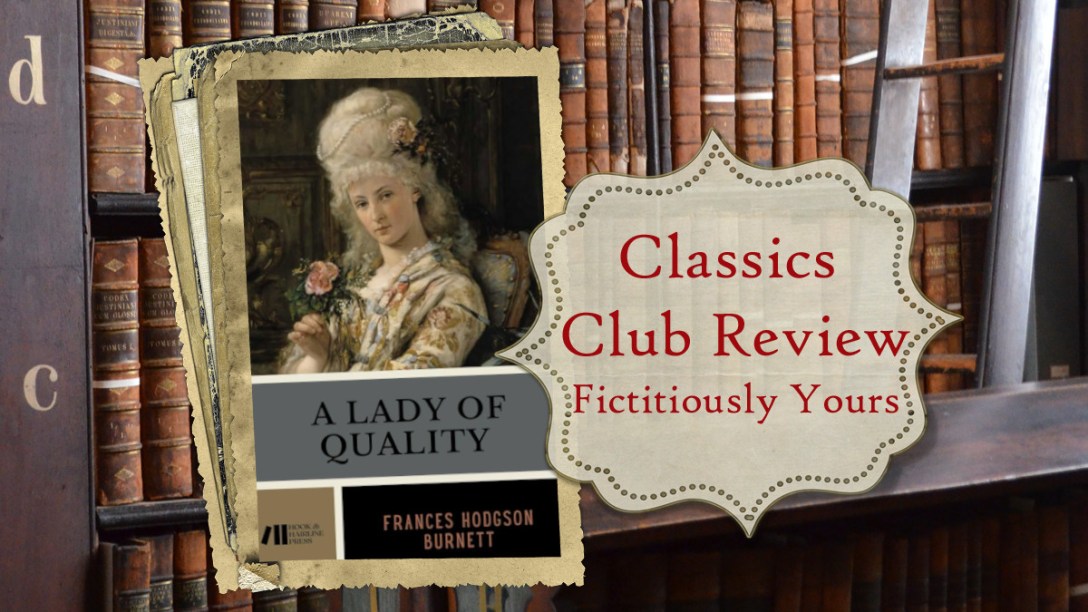
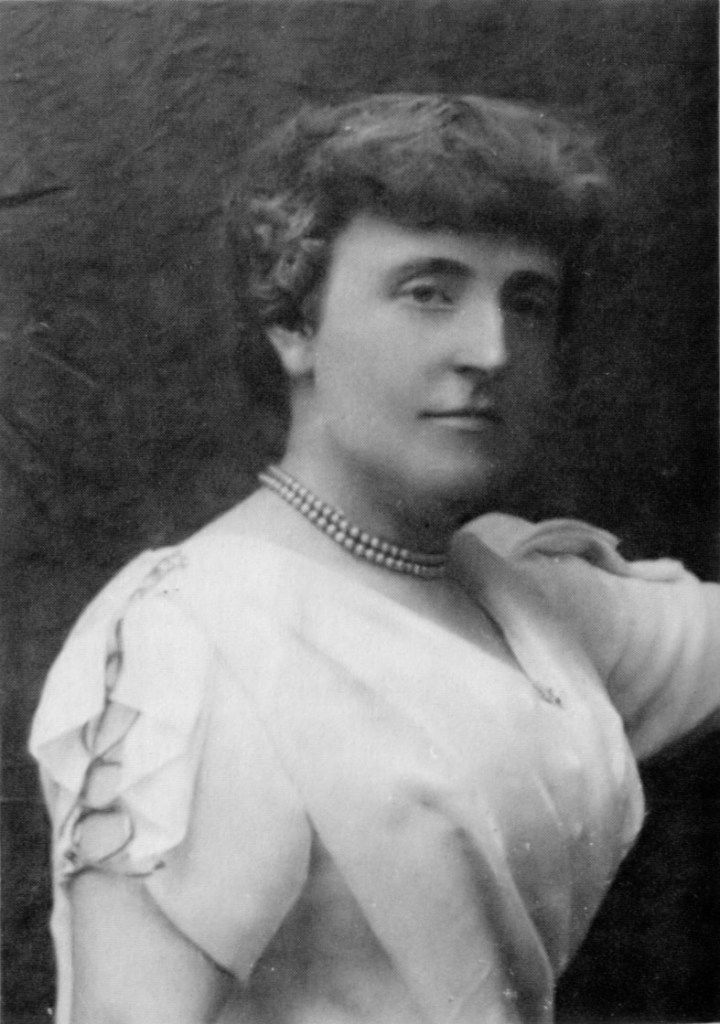
Frances Hodgson Burnett was born Frances Eliza Hodgson in Manchester, England on this day, November 24, in 1849.
If you thought Francis Hodgson Burnett exclusively wrote heartwarming children’s stories, that was me not long ago. The Secret Garden, A Little Princess, Little Lord Fauntleroy… even if you haven’t read the books, you’ve likely seen one of the approximately 386 adaptations of The Secret Garden, or one of several adaptations of A Little Princess, or heard the term “Little Lord Fauntleroy” used in some context, usually not complimentary.
I was surprised to learn that Hodgson Burnett actually wrote adult novels of historical romance which were bestsellers in her time, though they did not bring her the lasting fame she now has. So allow me to take you with me on this journey of discovery that actually took place over a year ago, but has only just now been committed to writing in the form of a review.
A Lady of Quality starts in a pretty dismal and disheartening place–a cruel and careless husband not heeding his dying wife’s wish for him to come see her one last time. Of course, his hunting excursion is more important than the birth of his ninth daughter and his wife’s imminent death. Because what lord needs daughters, let alone nine? And though he doesn’t know she’s actually about to die, what lord needs a wife who only produces daughters, and only two surviving ones at that?
But his ninth daughter doesn’t die. Clorinda has the fire of her father, and more–the determination to live on her own terms.
Their clash of wills, debauched middle-aged wastrel and spoiled bratty child, leads to the father taking his daughter under his wing as entertainment for himself and his similarly seedy friends. She’s a strong rider, learns to hunt with the best of them, grows up strong, willful and beautiful. She wears boy’s clothes and it’s all a little weird as she leans into her role as an amusing, subversive object who swears and carouses with the men. Until she turns sixteen.
Then, she decides, she is a lady. She dazzles all the fellows with a devastating gown and femininely dressed hair and announces that she will not accept their familiarity anymore. Now, she is an eligible woman who must cultivate the character that will recommend her in society. Her next point of business is snagging a rich husband, which she does with very little effort.
A bit of flirting with a man she knows is no good, just for funsies (and maybe she was a little bit enamored with him for a minute there–he was dashing and she was only a teenager), and then it’s on to the wealthy, shy, honorable older man–and by older I mean probably seventy. After she’s engaged, who should she meet but her fiance’s younger relative (I’m sorry if the details are spotty–it’s been a year), who is equally wealthy but handsome and closer to her age. Sparks fly, as they must! But Clorinda is nothing if not a woman of her word–so she marries the older man and is an attentive and loving wife, per her agreement, until she is widowed.
It is after this that most of the real story ensues. Clorinda meets the younger relative of her late husband again and a courtship, not without some back and forth, ensues. However, her past threatens to bring blackmail, murder, coverups, and trail of broken hearts.
I find myself summarizing plot from this novel because I don’t know where else to start. I discussed it with my sister, who lent it to me after she’d read it, and I concluded that I had a hard time relating to the central character. I didn’t feel that Clorinda had much internal conflict or even really experienced emotions. Of course she is said to, but perhaps the way she is written doesn’t leave that impression.
Like her sudden decision to become a lady and completely drop her father’s friends, she would just do things. She doesn’t encounter meaningful opposition or have to overcome obstacles of inadequacy or self-doubt. As a result, her character felt flat or perhaps impossibly idealistic. Everything she sets her mind to, she carries out, just like that.
Maybe (and this is entirely likely) the reason I don’t see much depth or relatability in Clorinda is because I’m just not like that. Maybe it’s the executive dysfunction in me, leading to me put off this review for a year, that makes me think that a person with a will of iron and quick to action like Clorinda is a bit too self-actualized to be true. And yet, I usually can relate to people in stories even when they are unlike me…
I had somewhat recently listened to an audio of The Secret Garden around this time, and I couldn’t help but compare Clorinda’s character arc to the character development of Mary Lennox. Mary goes from spoiled, neglected, and hard child to an open, joyous, and loving one through a series of circumstantial changes that awaken her childish wonder and give her purpose and friendship. Though the environment and people around Mary partially trigger the changes, Mary is an active participant in her own redemption and brings her own personality and character qualities to bear. Nor are all her circumstances positive–she still has many obstacles and less-than-ideal actors around her. To me, this makes Mary’s arc better constructed and more satisfying than Clorinda’s, though to be fair, The Secret Garden is a later work of Hodgson Burnett’s.
Clorinda on the other hand completely destroys nature versus nurture by happening to be born with physical, mental, and moral strength despite horrible circumstances. She had a wretched upbringing and there is no indication that she ever struggled with the way she was treated and taught to behave. There is no external impetus or catalyst for change; she simply wakes up one day and decides to be different, with no lingering effects or even any great difficulty in assuming the respectability and social graces she was never taught. It’s like she flips a switch.
(Quite different than what was foreseen in Anne Brontë’s The Tenant of Wildfell Hall if Arthur Huntingdon’s similarly harrowing corruption of his young son had continued into his son’s adolescent years.)
All of this is not to say that Clorinda doesn’t encounter problems–remember the rake she had a brief flirtation with before she married? Well, it’s an ill wind that blows no good and an ill wind brings this no-good back into Clorinda’s life as a dissolute wastrel looking to revive old acquaintances for his own gain.
The resulting conflict and revelations do lead Clorinda to make hard decisions and briefly lose control but then instead of her having to face up to a consequence, the problem is solved by someone else and little more is said about it. Although to give Clorinda her due she does exhibit characteristics of kindness and selflessness through some of the fallout, doing her best to reverse or mitigate the damage done by Mr. No-good.
So perhaps the lady of quality is not meant to refer to the lady whose qualities were hers without having to work for them, but to the lady who uses those unearned gifts to exercise generous qualities that do not come so naturally to her.
It would be like Hodgson Burnett to have meant something like that.
This has been my seventeenth Classics Club book review! Check out the rest of my list here.
 Fictitiously Yours
[…] The Ninth Daughter: A Lady of Quality Review – Fictitiously Yours November 24, 20245:43 pm Reply […]
LikeLike
How interesting! I had no idea that she wrote adult novels either. I’m quite tempted to read this but only because her children’s stories are so good. Clarinda sounds completely unattractive and while she gets what she wants, if she hasn’t grown or had good reasons to change then a reader would struggle to connect with her character. Terrific review!
LikeLiked by 1 person
My sister really liked it and thought the character compelling, so it may be worth seeing if you would feel the same! There are a lot of interesting things about it that make me think I would still read more of Hodgson Burnett’s adult novels even though I found this particular protagonist a bit hard to sympathize with.
LikeLiked by 1 person
It’s only been in recent years that I learned this author also wrote for adults. This one does sound interesting to me, so maybe I should look for it or one of her other adult novels.
LikeLiked by 1 person
Lovely review!
LikeLike