Ten years apart, set in two very different periods of Poe’s life, the films The Raven (2012) and The Pale Blue Eye (2022) may not seem very similar portrayals of the American poet. Yet, when I rewatched them recently in anticipation of the 175th anniversary of Edgar Allan Poe’s death, I found more correlation than I expected.
The Pale Blue Eye (2022)
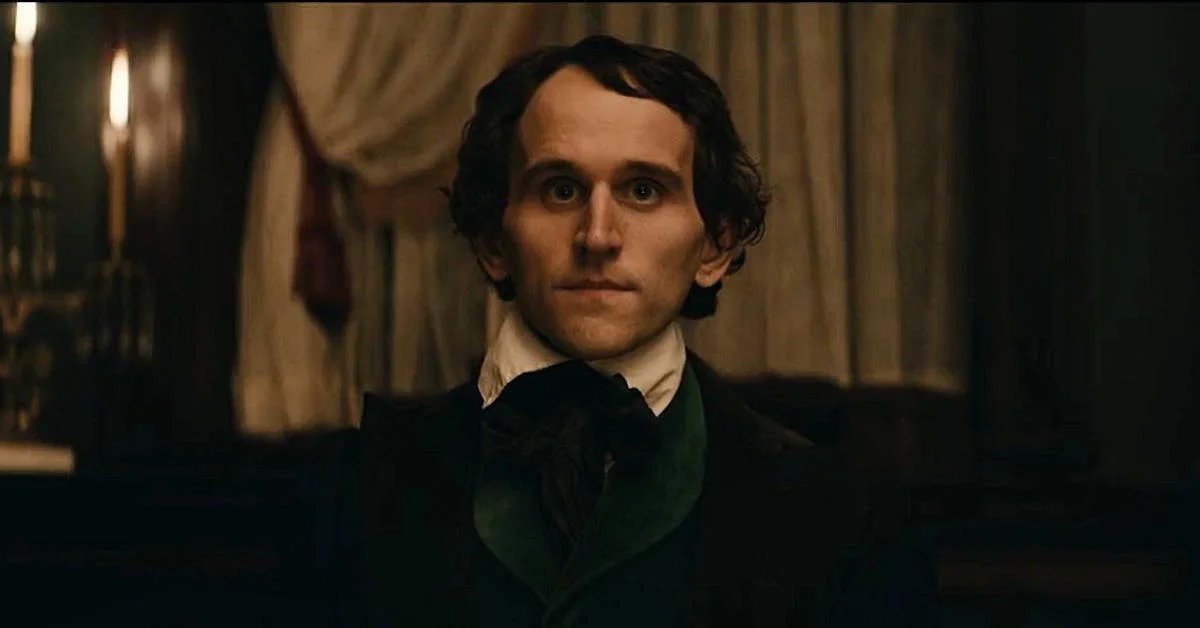
Though more recent, The Pale Blue Eye (based on the Louis Bayard novel of the same name) places its events nearer the beginning of Poe’s career, while he was briefly a cadet at West Point. The Poe of this time period, played by Harry Melling, has a vibrant and chaotic energy. He is fanciful, a touch naive, yet clever and compelling. Though his life up to this point has not been an easy one, it’s a lighter portrayal of the character who has not yet encountered the great heartbreaks that his future was to hold.
The Raven (2012)
The Raven by contrast takes place near the very end of Poe’s life. The title card relays the (mis)information that Poe was discovered dead in Baltimore on 7 October 1849 of mysterious causes. The following story attempts to account for the events leading up to his death. The Poe portrayed by John Cusack is critical, bitter, and jaded by the tragedies of his life. Yet, despite it all, his manner occasionally retains some of that frenzied energy and optimism.

Speech
One of the first things to notice about both Melling and Cusack’s Poes is their distinct manner of speech.
While young Poe at West Point has a slow southern drawl, his speech patterns and vocabulary mark him as different from his fellows–“ennui” is a favourite example of this. At various times he speaks fluent French, which Poe would have known, having gone to an English boarding school in his early years.
The older Poe played by Cusack, slurring or shouting his way through drunken proclamations, has not the same careful accent, though the distinct and articulate vocabulary remains to distinguish him from the prosaic speech around him. He also speaks French easily, and adds an element of cultured criticism to his dialogue that establishes his experience as a literary critic. Without data on how accents decay over time or what influence Poe’s various residences in New York, Philadelphia, Boston, or Baltimore would have had at the time, it’s conceivable to expect his accent to change somewhat.
Romance
Both Poes are hopeless romantics. The younger Poe of Melling is innocent and idealistic in his love for Leah, while the older, experienced Poe of Cusack is nonetheless committed to the aspiration of true love with Emily, despite his knowledge of the transience of life.
Furthermore, both Poes are unhesitatingly willing to sacrifice themselves for their love.
Mother
In The Pale Blue Eye, Poe relates getting messages or even poems from his mother in dreams which he then relates to events going on around him. Presumably this refers to his biological mother, Elizabeth Poe, who died when he was a toddler. However, his foster mother, Frances Allan, would have died only a year before his time at West Point and also had an influence in Poe’s life, though specific reference to her is not given in the film.
Cusack’s older Poe, having gone through the loss of many mother figures in his life, includes himself in a reference to “orphans” and briefly mentions his actress mother Elizabeth when the investigation takes them to a theatre where she had performed. Despite these being passing footnotes to the plot, the comparably breakneck pace of The Raven makes it noteworthy that it is mentioned at all, implying the significance to Poe.
Investigation
Both Poes become involved with a serial murder investigation, assisting an inspector throughout the films. Only the circumstances and settings are different, one being a secluded wooded area near West Point, another the crowded scenes of society in Baltimore, one mystery purposely baiting Poe, the other unintentionally tempting him with its interest and proximity.
Poe develops a relationship with the inspector in both cases and together they untangle many threads of the plot. Poe is also the one to ultimately confront the killer and understand the motive underlying everything. It’s a somewhat fanciful, yet expected, imagining of Poe as a solver of the kinds of mysteries he wrote about.
Poet
Melling and Cusack each declare, almost upon introduction, that he, Poe, is a poet. They are equally sure of this, one only with the substance of aspiration (Poe at West Point had already anonymously released one poetry collection to little success), one with the proof of years of work and dedication.
The young Poe comes through the twisted tale of madness, mortality, and revenge with a sense of gravitas, having faced horror and gained wisdom that may inform his art to come.
Poe near the end of his life comes through his ordeal with a renewed sense of who he is and has always been–who his life has made him. He regains respect for his art and the way in which it cannot be imitated.
Where young Poe sees an unequivocally poetic symbol in the human heart, the elder Poe sees a similar symbol of the human tongue to be prosaic and cliche.
Unalike
The pace and purport of The Pale Blue Eye has a personal element to it that The Raven fails to cultivate. The Pale Blue Eye‘s Inspector Landor played by Christian Bale has a uniquely developed character with stakes in the plot, whereas his counterpart in The Raven, Inspector Fields, has no such discernible motive or development. However, Luke Evans who plays Fields is enjoyable in his supporting role and conveys much more depth of potential than the script or editing allowed his character.
The revelation of aspects of the crimes are measured in The Pale Blue Eye, frantic in The Raven. Chases and breathless confrontations litter the events of The Raven, while quiet conversations and lingering looks punctuate those of The Pale Blue Eye.
The Pale Blue Eye has a prophetic element for Poe’s life, while The Raven compiles a retrospective of his life and works.
Some aspects of the events in The Pale Blue Eye remind me of Lovecraftian or even Hawthorne-ian influences and give it a multi-layered atmosphere as the crimes themselves are multilayered. There is a bit of tension in tone between plots throughout that isn’t fully resolved by the ending which leaves the tale feeling disjointed at points. Yet there is an encircling thread to the narrative that harmonizes the disparate elements in a way that is satisfying enough and is maintained by the consistency of the historical grounding in accents, dialogue, costuming, and set design. The performances of Christian Bale, Gillian Anderson, and Toby Jones give strong support to Harry Melling’s inspired Poe.
The Raven, while rich in its costuming and style, has more of a modern feel to its execution, with occasional cliched dialogue seemingly just to give a character something to say. The priority in The Raven is the serial killer horror, not accurate historical portrayal. This is evident from the first title card, which, as I mentioned, gives misinformation on Poe’s death simply to fit with the timeline of the film’s events. Yet, I enjoyed this movie for all that and it seems to admit its shortcomings via metatextual commentary on those who would try to imitate or emulate Poe. As a fan of the show Lark Rise to Candleford, I was also excited to spot in a couple of minor characters the familiar faces of Robert Timmons (Brendan Coyle) and the Philip the Gamekeeper (Oliver Jackson-Cohen).
If you’re at all interested in a Poe or mystery thrillers in general, I would recommend watching either of these films to enjoy a varied look into Poe’s life and times. Both Harry Melling and John Cusack embody believable facets of Edgar Allan Poe’s personality and character at different points in his life, and the undying the poetry of his soul.
It is not the purpose of this paper to do more than give, in detail, a picture of Mr. Landor’s residence–as I found it. How he made it what it was–and why, with some particulars of Mr. Landor himself–may, possibly form the subject of another article.
Edgar Allan Poe, Landor’s Cottage
 Fictitiously Yours
[…] rewatched both of these movies recently and have plans to put out a comparison post considering how they portray Poe and reference his work. In the process of researching for that, I […]
LikeLike