[W]hile I have Udolpho to read, I feel as if nobody could make me miserable. Oh! The dreadful black veil!
-Catherine Morland in Northanger Abbey
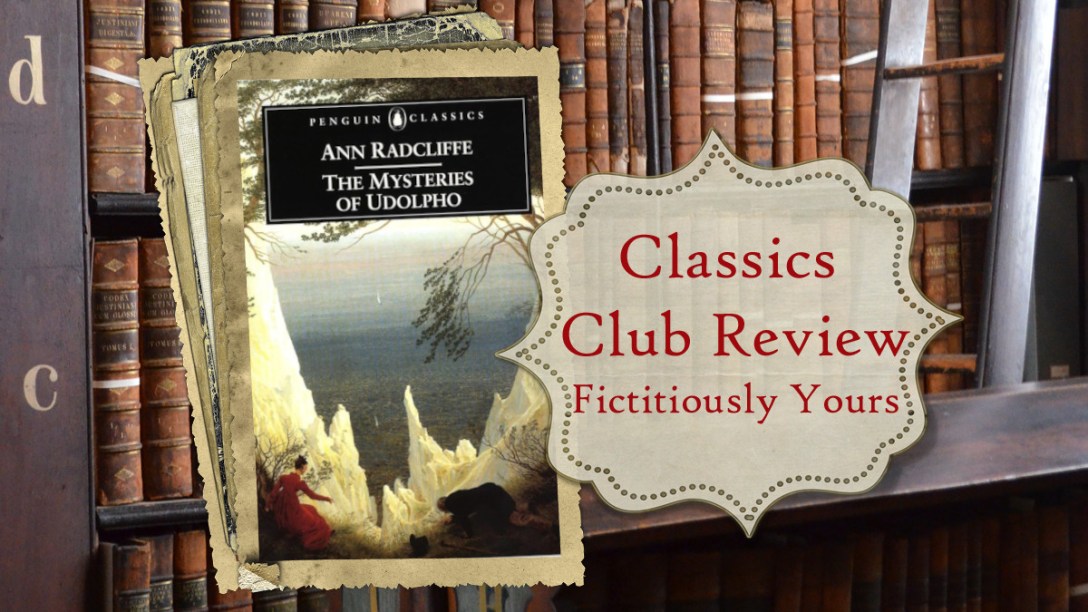
The Mysteries of Udolpho (1794) by Ann Radcliffe
Since hearing about Radcliffe’s influence on the gothic literary movement of the eighteenth and nineteenth centuries, I have been interested in reading her work and finally read The Mysteries of Udolpho earlier this year for book club, doubling as a Classics Club selection.

Young Emily St. Aubert’s idyllic life is marked out for tragedy when her parents both die soon after one another and she is left in the guardianship of an unscrupulous widowed aunt. Her one consolation rests in Valancourt, a young man she met while on a trip with her father, but her aunt does not approve of him and forbids their correspondence. Soon her aunt remarries to a shady Italian, Count Montoni, and transports the household from France to Venice, Emily is out of reach of Valancourt or anyone who might reasonably protect her.
While life in Venice at first appears benign enough, Emily is soon the subject of the avaricious Montoni’s schemes to marry her off to someone wealthy. These plans are interrupted when Montoni packs the family off in the dead of night to his castle in the wilds of Italy plagued by warring tribes of banditti. It is called Udolpho and it came into Montoni’s possession under mysterious circumstances involving the former owner, the beautiful and willful Signora Laurentini, who supposedly disappeared without a trace twenty years prior.
There, Emily has to contend with sinister passages, imprisonment, ghostly apparitions, duels, phantom music, bands of brigands, would-be assassins and saviours, and of course the horrific item concealed by the black veil.
Growing up the beloved only child of her father and mother, living idyllically on their small estate chateau in France, Emily has no experience with such circumstances as she now finds herself in. However, she draws on the admonishments of her father who always advised her to be resolute and use her logic, sense, and morality to make important decisions, rather than letting romantic feelings lead her astray.
‘So, ma’amselle, I came to tell you all this … what can these ill-looking men be come about, if it is not to murder us?’
‘Is this all you have to tell, Annette?’ said Emily. ‘Have you heard nothing else, that alarms you?’
‘Nothing else, ma’amselle!’ said Annette; ‘why, is not this enough?’
‘Quite enough for my patience, Annette, but not quite enough to convince me we are all to be murdered.’
-Ann Radcliffe, The Mysteries of Udolpho
Her father’s advice usually stands Emily in good stead, and she encounters her off-balancing and terrifying new world with a fair amount of resilience, especially when it comes to resisting Montoni’s overbearing pressure and threats. Emily is also the moral lodestar of her romance with Valancourt, who is a lot more vacillating and prone to hysterics than she is, and she is also not an “I can fix him” kind of girl, which nearly has disastrous implications for their happy ending when Valancourt is accused of disgraceful crimes.
But, alas, Emily has her faults as the plot demands, so she also spends a good deal of time sighing at her bedroom window through the small hours of the night, which puts her in optimal place to be terrorised into fainting fits by hearing mysterious singing in French or seeing a spectre glide along the ramparts below her. All adding to the horror and thrill of the atmosphere, of course.
The title of the book is by no means an exaggeration: mysteries (plural) it says, and mysteries (plural) it has. Throughout the entire story, Emily keeps seeing mysterious figures dodging between the shadows of trees in gardens when she goes walking about alone after dark (which our book club kept calling her out for), or hearing mysterious music, or encountering pictures of mysterious women. While the primary scene of all of the mysteries is not necessarily in or around Udolpho, they all converge at or originate from Udolpho in some way.
The descriptions run rampant and the commas are similarly abundant, the grammar is nonstandard and the plot is meandering. You thought Shakespeare was out of pocket for throwing random pirates into the plot of Hamlet? Well, Radcliffe was recognizing that as genius and taking notes.
Throughout, Radcliffe builds a setting of superstitious tales, superlative nature, and scintillating crimes. She puts poor Emily through the wringer, only to use her as an illustration of the triumph of good sense and moral fiber. And all of the supposed hauntings are explained in the end. Perhaps the true ghosts were the friends we made along the way.
Altogether, I was delighted to have read The Mysteries of Udolpho with the book club, able to slow down and discuss impressions, guess at the mysteries, express shock at the twists, as well as frustrations, whether with pacing or characters (ahem, Emily and her solo night walks!).
This has been my fifteenth Classics Club book review! Check out the rest of my list here.
 Fictitiously Yours
You really do make this sound good! It’s going to have to be tagged to my wishlist at the library, whether I ever get to it or not.
LikeLiked by 1 person
[…] The Mysteries of Udolpho (1794) by Ann Radcliffe¶ […]
LikeLike