
Here’s the problem with making a complex secondary character a main character in their own novel: they lose some of the mystical quality that makes them interesting to the reader to try and interpret. Also, quite often their “voice” as the perspective character loses some of what their established personality has been. They are no longer defined by how they present themselves, act, and how others perceive them. Now, the reader has direct access to their internal life, losing some of the unpredictability and impact their presence has heretofore effected.
Hence, Murtagh, mysteriously motivated, morally grey, sometimes ally, sometimes enemy of Eragon in the original Inheritance Cycle, becomes fairly dry in his characterization once he’s the sole and only perspective character of his own novel.
But that’s getting ahead of myself.
Firstly, I got dragged into this story by main force, with impressions of Murtagh’s characterization grown hazy in my mind since reading the Inheritance Cycle probably ten years ago. I’ve re-read Eragon at least once since then, but that still leaves a lot of the critical developments from later in the series undefined. So, I accepted the initial introduction to Main Character Murtagh’s perspective with a willingness to suspend disbelief.
By halfway through his first conflict encounter, I was a little less willing.
In it, Murtagh makes a critical error of judgement that I could easily see would lead to endangering an innocent child, which doesn’t even seem to occur to him in his mistaken assessment of his antagonist. Lo and behold, it does end up endangering the child. From there, Murtagh consistently walks into dangerous situations with one predicted outcome, and completely misses the actual threat until it’s too late and he has been blindsided.
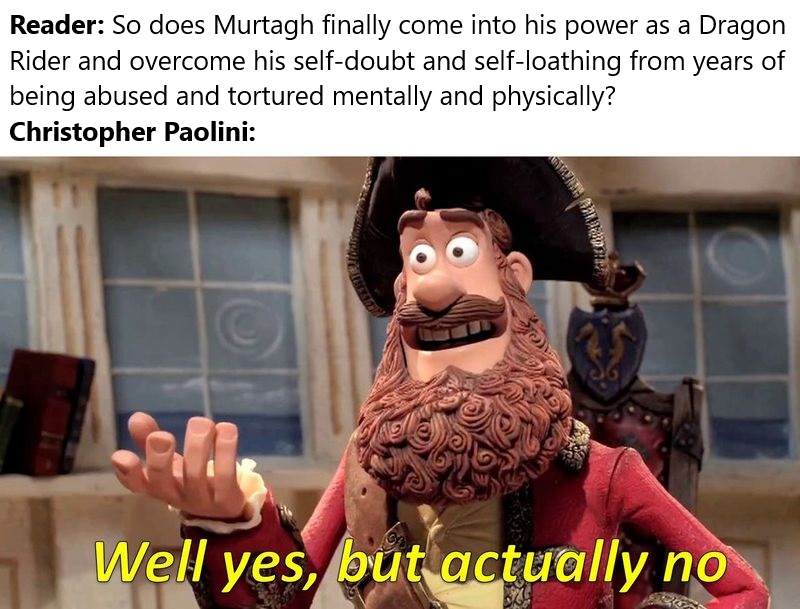
Well, that’s fine, you say. He’s just not that good at reading people or situations then. He has to have some weakness, after all. Good thing he’s a Dragon Rider and has unchallenged strength and speed and magic and fighting abilities.
Well, yes, but actually no.
See, he has all those things when it’s convenient for him to be matched against the small fry who try to bushwhack and rob him outside a seedy Gil’ead tavern. Then the narrative waxes on about how his abilities are way out of the league of the likes of the puny muggers and he has to restrain himself to keep from doing as much damage as he could (which, well, doesn’t to seem to actually be all that much restraint, generally, from the devastating mangle of bodies and severed limbs he leaves in his wake, but that’s Murtagh for you).
But let Murtagh be pitted against someone with a bit of mojo and suddenly, despite Murtagh’s self-assessment at still being more powerful than them, he gets laid out with one surprise attack or he miscalculates his defensive position and lets something through his guard, and the jig is up.
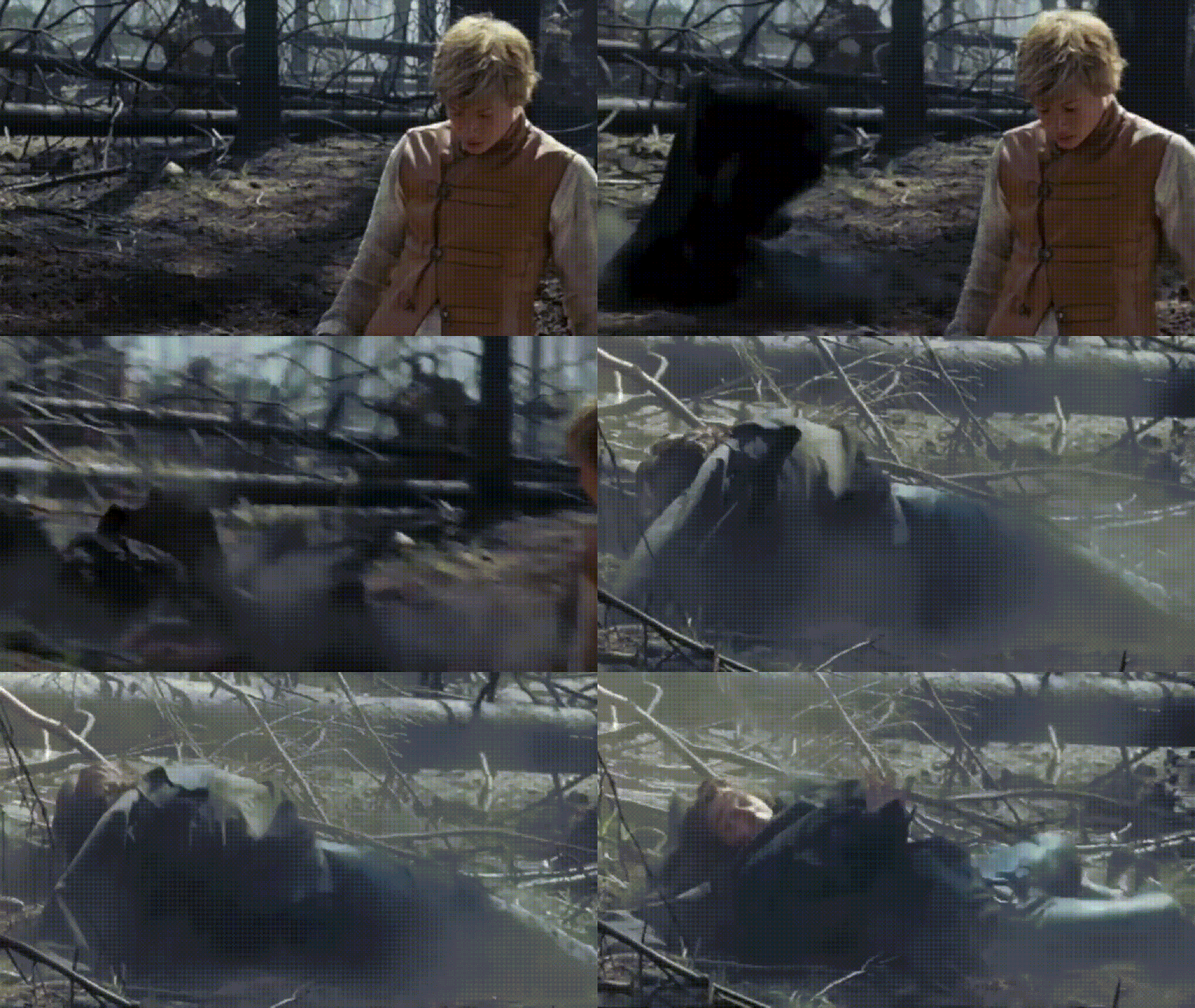
Murtagh consistently spends his time on his back foot in just about every situation. What appears to be caution and cunning in his actions just effectively puts himself wholly at the mercy of the villains. And it’s not like that should take him by surprise, because he’s often thought through possibilities before he gets into situations! But he thinks them through, and then decides against what his better judgement tells him, instead choosing to let events play out as the villain determines they should.
So here let me justify why I enjoyed reading this book, rounding it up to four stars on Goodreads, despite the above-mentioned frustrations:
It kept me hooked. Once I got past the Paolini trademark Tolkien imitation writing style, which, admittedly, sometimes threw me out of the story, I was interested and invested in Murtagh and Thorn’s journey–an attempt to find as well as redeem themselves.
Murtagh has a bad track record of getting manipulated and led around by people, even well-meaning ones. After being able to break free of Galbatorix’s mind control, it’s not surprising that Murtagh takes the opportunity to go do his own thing rather than signing up for his next master by becoming part of Nasuada’s force of magicians or Eragon’s school of dragon riders.
I say this now, although when I read Inheritance, I was pretty nonplussed at what I thought was Murtagh’s flimsy rationale and obstinance in his choice (I think I had also read Jo’s Boys around that time and was angry at Dan for doing something similar). But the years have mellowed me, so I say, “Sure.” Thusfar, I am with the characterization.
Murtagh, tainted by his complicity (willing or not) in Galbatorix’s crimes, decides to test his limits and follow his own judgement by investigating a sinister report and determining whether it is a threat or not. He sets out to be a proactive force in the world for good, essentially. This is a decent basis for an active protagonist driving his own story, and for the first half of the novel, it succeeds more than it fails.
We see Murtagh choosing to continue investigating, initiating contact with informants, pursuing leads, and planning operations. At the same time, he’s continually training, working on his weaknesses, and assisting Thorn with his deep-seated claustrophobia developed during his confinement and torture at the hands of Galbatorix.
As he progresses through obstacles, Murtagh’s increasing awareness of the extent and seriousness of the danger leads him to rethink doing it all on his own. However, each time, he is held back from asking for Nasuada or Eragon’s help by pride and shame in equal measure: pride because he needs to prove to himself that he is strong enough to face challenges on his own, shame because of the part he played in the war. Despite the events in Gil’ead feeling like a string of video game sidequests, as one reviewer put it, the various interactions and situations Murtagh has to navigate progresses his character in believable ways.
The discoveries and outcomes of his Gil’ead sidequest result in him traipsing across the country to find the source of the evil he’d been hearing about in a city ruled by the witch Bachel. (When I tell you the whole story I was thinking of this as rhyming with “Rachel” only to be told at the end it is pronounced “Rachelle”… well, it’s too late by then.)
Once there, I liked how the location fed into deeper lore surrounding the past with Galbatorix and Murtagh’s father, Morzan, although I could have used a few less flashbacks to events we already knew about (particularly when they don’t quite align with what we know of them before, such as Murtagh’s scar… but I digress). The intrigue about the Forsworn and Bachel’s cult added layers to the history of the whole series that build up some promising room for expansion and exploration. I was prepared for this to be more developed, particularly with the added intrigue of the unknown member of Nasuada’s court showing up near the end. (Set up for book 6? Which will actually be book 5, because apparently Murtagh isn’t the official book 5, but a secret third thing…)
However, this part with Bachel is overall probably my least favorite. While there were a few minor places Murtagh changes his mind with seemingly no reason before, now I almost got whiplash from his waffling.
Which is unfortunate, because his initial estimation of the situation is pretty reasonable. He doesn’t think it wise to let himself be lured into Bachel’s turf, and is prepared to cut and run for help if anything gets dicey. If he had stuck to this intention instead of, again, just afterward going along with the villain’s agenda, he would have been much better off. Not less because Bachel tells him point blank that her plan is to have him join her, which should have put him more on his guard, not led to him going along with more and more as the days progressed.
Because he does go along more and more, reasoning himself into the false hope that by being civil and persisting in asking questions, he might get some straight answers, despite Bachel continually evading said questions and putting him off and shoving more food or entertainment at him to shut him up. Like, get a clue.
This is the longest two days in the book, when Murtagh is fooling around trying to lull Bachel into a false sense of security and tell him what he wants to know, while she is giving him nothing. Murtagh here does not shine as the brightest blade in the smithy. He repeatedly insists on never being enthralled again, for obvious reasons, yet he continues to let himself be drawn in by Bachel after she has told him outright that she is confident he will serve her. Man, just get out.
It is so late in the visit by the time he decides to stand up to her, that it is in fact too late. When the pretenses drop and Bachel actually promotes Murtagh to “threat” instead of “lovable chew toy,” it’s almost a relief. To me anyway, despite what follows. At least now we know what we’re in opposition to.
The rest of the book swirls by in a haze of pain, dreams, and aphasia, as Murtagh resists the call of the dark side–from inside himself.
Okay, that’s a bit dramatic and reductive, but I can’t give away the whole plot.
Instead, I will touch on some of the further weird characterization of Murtagh that threw me off a bit from totally buying his development of self-determination.
So, after an early violent encounter with Bachel’s minions, Murtagh is mentioned to be painstakingly careful when he’s cleaning up afterward so he doesn’t touch the blood. Which, okay, reasonable–who wants viscera all over themselves? However, because it is given such particular mention rather than simply summarizing that he changed his clothes or whatever, I wondered if it was leading toward revealing that he has developed an aversion to violence, blood, or something related to when Galbatorix forced him to kill and maim people. That seemed entirely possible given the extent of his trauma, especially with the Nasuada situation.
So, I kept an eye for more mentions or developments, especially as air time was being given to Thorn’s claustrophobia. Instead, we got flat contradictions, stating that Murtagh doesn’t mind guts and isn’t queasy about it. Okay… but now we’ve also gotten indication that he is afraid of spiders (also connected with past torments at the hands of Galbatorix), and yet he also flatly denies being afraid of spiders when he’s warned about an underground passageway’s decrepitude. Clearly, he’s putting on a face and lying. So was the insistence that he doesn’t mind guts also a lie? Now we don’t know.
Then later in the story Murtagh, albeit drugged and compelled, seems to literally get high off of fighting. But then, seeing the result of his destruction, he’s nearly physically ill. Maybe an aversion… oh, wait, no, it’s just due to him realising the identity of his opponents.

So, outside of that context, Murtagh seems to be fairly unbothered by violence on the whole. Okay, so perhaps my initial estimation of its significance is just reading into it…
But then, not long after, when fighting his way to the boss battle, Murtagh evinces demented delight at hacking and slashing his way through Bachel’s minions. It’s a little more than pride in combat skill and athletic ability. It’s a little more than adrenaline fueled euphoria. It’s kind of psychotic.
But again when defeating Bachel, he has to kind of look away from the mess resulting. So does he have a problem with gore or doesn’t he?
This is just another example of the disconnect between some of the things we are told and shown. It’s like he’s being written as a well-meaning good guy that we are meant to root for, because he’s the protagonist.
But then he can’t be too Eragon-y, so then it’s like periodically there’s this upsurge of some latent hardness and bloodlust that is more reminiscent of Murtagh from the previous books. But it doesn’t appear consistently, so it feels like an up and down kind of thing which doesn’t support his character arc overall, much like most of his attempts at strategizing.
All things considered, though, I enjoyed reading it. The plot and developments are nothing if not calculated to keep you invested in what happens next, however much they have to undermine the character’s agency and progress to do it. I was riveted to the narrative, and not just because I had other books to read that I was putting off.
No, I think this is genuinely a good continuation of the Inheritance Cycle, even if I would have probably hated it if it had come out ten years ago and I read it fresh off of Inheritance. (Listen, I was so desperate for more story with Murtagh after slogging through those last couple books’ thousands of pages that I went to Wattpad to look for Eragon fanfiction. It was there I learned what slash fiction was, and it was there I left it.)
So, with the benefit of hindsight, I can say that Murtagh shares some of the other books’ weaknesses (e.g. it’s too long and had me wondering if the editor was on holiday when it got pushed to printing), while carrying on with a lot of the strengths. It’s worth reading for anyone who likes the world and characters, enjoying a breakneck adventure plot without stopping too long to critique the characterization.
Then again, I liked Garrett Hedlund as Murtagh in the Eragon movie, so that may disqualify me from all credibility.
 Fictitiously Yours