
Blurb for The Marble Faun, or The Romance of Monte Beni, by Nathaniel Hawthorne
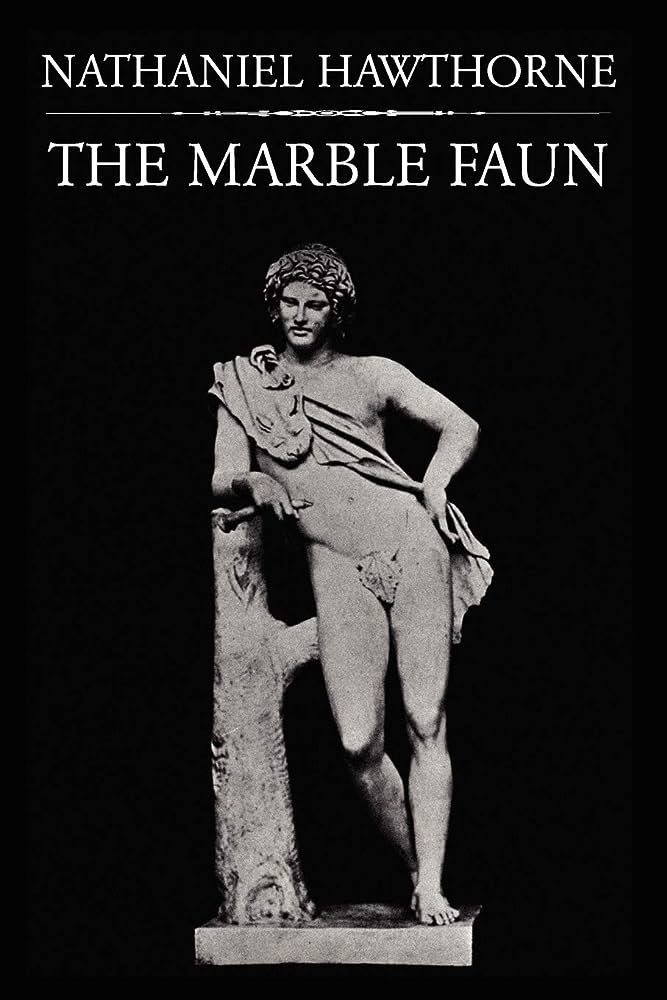
The fragility-and the durability-of human life and art dominate this story of American expatriates in Italy in the mid-nineteenth century. Befriended by Donatello, a young Italian with the classical grace of the “Marble Faun,” Miriam, Hilda, and Kenyon find their pursuit of art taking a sinister turn as Miriam’s unhappy past precipitates the present into tragedy. Hawthorne’s ‘International Novel’ dramatizes the confrontation of the Old World and the New and the uncertain relationship between the ‘authentic’ and the ‘fake’ in life as in art. The author’s evocative descriptions of classic sites made The Marble Faun a favourite guidebook to Rome for Victorian tourists, but this richly ambiguous symbolic romance is also the story of a murder, and a parable of the Fall of Man. As the characters find their civilized existence disrupted by the awful consequences of impulse, Hawthorne leads his readers to question the value of Art and Culture and addresses the great evolutionary debate which was beginning to shake Victorian society.
My Review
My last Classics Club Spin turned out to be The Marble Faun and I couldn’t have been more excited! I’ve been wanting to read this book soon, and it turned out to be the perfect summer read. Is it light? Not really. Is it emotional, evocative, and excessively concerned with aesthetics and art? Yes!
It is, to my delighted discovery, a perfect candidate for the label of “dark academia” with its artist main characters, themes of guilt, crime, and decay threaded with beauty and tainted love. I happened to start reading The Secret History by Donna Tartt (the dark academia book of all dark academia books) while reading this, and I was struck forcibly by the many similarities.
The Marble Faun also dips into a gothic tradition with its archetypes (arguably, modern “dark academia” is also strongly influenced by gothicism so I suppose it’s part and parcel) of the pure, spotless maiden, the somehow fated titled aristocrat, the “fallen” or somewhat morally ambiguous woman.
The scene of the majority of the story is Rome, a city rhapsodized about by the author as both a decaying, pestilential ruin and a magical resevoir of a glorious, inspired past. Informed by Hawthorne’s visits, the setting is detailed and rich with living colour. No sketchy outline or vague environs here; everything is thrown into such sharp relief that it almost surpasses realism and reverts again into fantasy. It’s like watching a movie that wasn’t shot in HD, now remastered in super HD. It just looks a little too clear, like it’s portraying things that no one ever really saw.
Gone is the New England mist we have come to expect from Hawthorne with his fables; here his characters move in the stark sun against the solid background of a granite past: three artists living in Rome and two of their models.
First, the painters: Hilda and Miriam. Hilda is the pure and flawless imitator of the masters, who lives her saintly life a bit on-the-nose, inhabiting a tower that houses a shrine to the Virgin, which she keeps lit at all times despite not having any devotion to Rome, accompanied only by the doves who roost in the tower. But is her innocence a bit inhuman?
Then there is Miriam, the mysterious and exotic beauty, the dark mirror of Hilda, dissatisfied with the cold and inhuman ideals of the masters, seeing the passion and fatality to life, hounded by her past in the form of a dark shadow figure who literally dogs her every step. She begins as the classic gothic hero (yes, I say “hero,” not “heroine”).
Next, the sculptor, Kenyon, dealing with the base of clay to form masterpieces that will stand for time immemorial, the man of mud trying to mould an immortal soul and find a helpmeet fit for his work (spoiler alert: it’s Hilda). Confidant and companion to the painters, Kenyon is a gentlemanly and noble character, not only loyal to his fellow artists but to Donatello, to whom he becomes a true friend.
Then the models: Donatello and “the Shadow,” who is never named. One, an innocent young man of no great intellect but vibrant animal spirits who is enamoured with Miriam to the point of worship, the other a malignant stalker with doom in his countenance who seeps out of the catacombs of Miriam’s past to set his mark as a blight on her life.
As I think about it more and more, the way in which Hawthorne brings out themes in the art he describes to foreshadow events and critical themes in the novel is astounding. Of course, the most obvious seems to be the titular marble faun, whose likeness Donatello seems to share in more ways than one. But even less obtrusive examples of art the group of friends discusses gives a fateful cast to future events and their significance.
One of the paintings that Hilda is particularly fascinated with is Guido’s depiction of Michael the Archangel defeating Satan. She is moved by the ultimate triumph of good over evil, and the untouched, heavenly glow that Michael seems to exude on his placid countenance as he effortlessly subdues the Enemy.
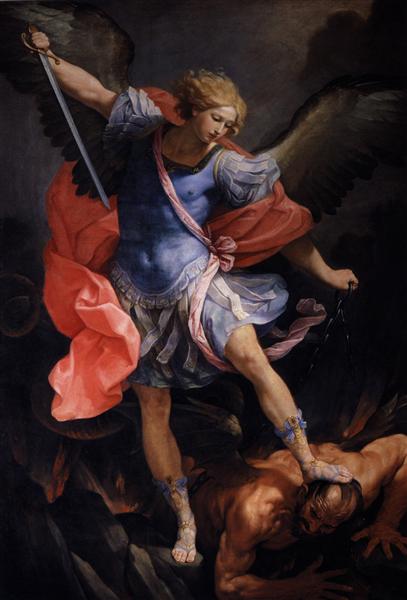
Miriam brings up the complete misunderstanding the painter must have had of any real struggle between good and evil, arguing that Michael would be bloody and wrecked after any true battle with Satan and that in the end the passion he would have had to go through to defeat him would be reflected by madness in his face. Perhaps, she goes so far as to suggest, he would even be driven to succumb to darker passions in the course of the battle so fiercely fought, which would taint his victory’s purity as it secured its finality.
This image, among others, represents part of the main struggle of the novel and the roles that the two models play. Interestingly, the models are pitted against one another, vying for Miriam, one pulling her toward innocence and light, one pulling her toward guilt and darkness. Yet, ultimately the struggle is not man against man, but man against himself.
In one move, Donatello defeats the external evil only to have it reborn within himself. Michael, triumphant, and become the Devil.
It’s a brilliant novel, despite its lack of notoriety, and it deals with its themes in what is apparently a characteristic, Hawthorne, black-and-white manner, only to surprise you with more nuance than many a gothic novel before (or after) it. For instance, it invites the reader to ponder whether innocence can possibly be more virtuous than knowledge, and whether a fall is actually necessary for transcendence.
It considers the nature of religion, piety, morality, sin, and innocence. It basks in the aesthetic delights of life and art, their successes or failures at portraying humanity and spirituality as it really is. It considers the extent to which confession can be said to be good for the soul (hint: it’s nothing that contradicts the effects of confession Hawthorne portrays in any of his other works).
It dips into predictable plot points and character roles at times, but uses them to create interest and momentum, often subverting expectations or further shrouding the events in mystery. While there are aspects of the novel’s trajectory and construction that sometimes seemed thin, I really enjoyed it over all. The atmosphere and imagery alone will stay with me for a long time.
I would recommend it to anyone who enjoys gothicism, exoticism, art, or whatever of the many classifications of “academia” you prefer: light, dark, chaotic, there’s something here for everyone.
This has been my eleventh Classics Club book review! Check out the rest of my list here.
 Fictitiously Yours
[…] The Marble Faun (1860) by Nathaniel Hawthorne […]
LikeLike
[…] I fell in love with Hawthorne’s writing at 16 through reading The House of the Seven Gables and completely losing my mind at how he manages to make an entire chapter describing a house/room with only a dead occupant in it compelling. I’ve also read most of his short story collections since then, as well as most of his completed romances–The Scarlet Letter, The Blithedale Romance, and The Marble Faun. […]
LikeLike