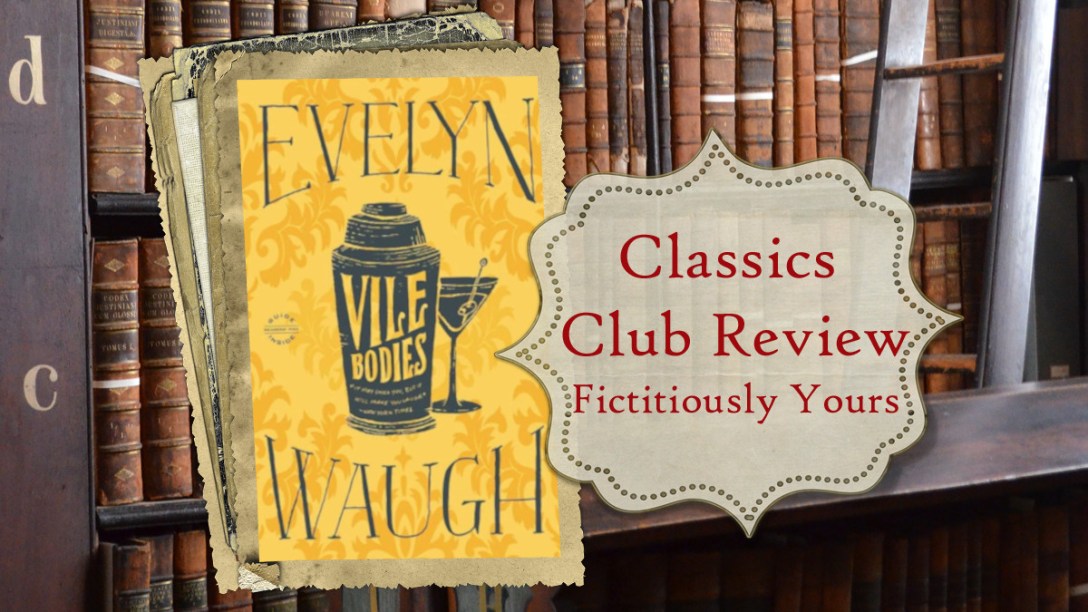
Blurb for Vile Bodies by Evelyn Waugh
The Bright Young Things of 1920s Mayfair, with their paradoxical mix of innocence and sophistication, exercise their inventive minds and vile bodies in every kind of capricious escapade, whether it is promiscuity, dancing, cocktail parties or sports cars. A vivid assortment of characters, among them the struggling writer Adam Fenwick-Symes and the glamorous, aristocratic Nina Blount, hunt fast and furiously for ever greater sensations and the hedonistic fulfilment of their desires. Evelyn Waugh’s acidly funny and experimental satire shows a new generation emerging in the years after the First World War, revealing the darkness and vulnerability beneath the glittering surface of the high life.
My Review
In the beginning, a literal crush of bodies takes the stage as a collection of passengers aboard a claustrophobic vessel crossing the channel to England. I found it a bit difficult to follow who everyone was, but as the story continues and the passengers disembark to their various social circles and occupations, they start to emerge from the smosh of the initial chapters. There’s a poor novelist, a debutante who is engaged to be married to him provided they can scrape together enough money, a gossip columnist, as well as their various dissolute friends and acquaintences who make up the rest of the cast of in-and-out characters.
At first, with much of the action confined to witty dialogue containing references to things that I wasn’t always familiar with, I didn’t know if I was going to “get” the black comedy of the story. Much of it seems to reference current events and perceptions of the time, and with my vague grasp of British social and political events of the 20s and 30s, I am sure there is a lot that I completely missed and failed to appreciate.
However, persisting in reading it, situations and events arose with the characters carrying-on throughout them with a particular high-handed whimsy, even the most desperate and desolate of them, which I was able to follow better and appreciate. It impressed me at times as a dark mirror to some of P.G. Wodehouse’s writings, for its comedy and caricature, though Wodehouse tends to be more forgiving in outlook, whereas Waugh does not shy away from brutal consequences.
I came to the end of the novel with a sardonic smile on my face and was surprised to recall that there were several rather tragic casualties throughout the novel, including several young people, a marriage, and the peace of Europe. Somehow, Waugh kept up a tone of patent absurdity throughout that simply does not allow the reader to process these deaths in anything like what we might think of as the “proper” way.
To me, that was the best proof of Waugh’s success at executing his purposeful lampooning of British society of the time, with its useless titled people, government showmanship, and relentlessly unprincipled conmen of every class. Everything, of course, is grist for the gossip mill, and the rest of the principal is made up by creative writers inventing whatever they don’t know.
A couple of the characters emerge from the scrum as those we are most likely to sympathize with, the engaged couple facing lack of funds. Their abortive attempts to cop a fortune (or any money, really) however they can become a running gag that makes up much of what I would call the plot of the novel.
The repeated attempts of the fiance to hit his potential father-in-law up for support is as frustrating and ridiculous as it is futile, with the father-in-law’s behaviour reminding me suspiciously of Charles Ryder’s practical joker of a father in Brideshead Revisited. Waugh must have known someone like this, to use the frame for two different characters in two vastly different novels.
There is a lot of drinking, gambling, various forms of entertainment from parties that swing from chandeliers to religious pageants, horse racing, motor racing, costumery, gambling with livlihoods and lives, all lurching toward the eventual denoument in the killing fields of France, reclaiming a moment of that former carefree idyll in the midst of horror, peril, and destruction. Perhaps these latter things were closer all along than anyone cared to acknowledge.
I came away with a feeling of nostalgia for a wasted and lost generation, who were forgotten in the midst of their forebears’ shortsighted running of society and then obliged to a rude awakening fighting the war that resulted from the mismanagement. It’s a sad truth that young people who aren’t wanted in places of influence and power will find themselves in high demand when those who hang on to the power suddenly need soldiers for a war.
On the other hand, the young people as portrayed in this novel are not in any way capable or interested to take over anything, because they’ve never had to take responsibility or been expected to be self-sufficient, though their elders aren’t much better. It’s a failure of generations in training the next one to be productive or successful, perpetuated by society’s petrified and obsolete customs.
Does Waugh propose a solution? Hardly. It’s a satirical novel of the highest order, scathing in its insight into society’s most ridiculous characters, piercing flesh and bone with its unwavering examination, unflinching from what we as humans want to glance over or disregard: the vileness of our bodies, both physical and governing.
This has been my tenth Classics Club book review! Check out the rest of my list here.
 Fictitiously Yours
[…] Vile Bodies (1930) by Evelyn Waugh […]
LikeLike