
A philosophic aside
If something is not untrue, is that the same as saying it is true?
Let me provide a parallel example: if someone is not wrong, does that mean they are right?
I’m fairly confident anyone with the slightest degree of ability to grasp nuance of language would instinctively, if not confidently, say that being deemed “not wrong” is not equivalent to or synonymous with being “right.” But why not?
Forgive a fanciful illustration that has come to me on the spur of the moment. Say you are watching to a music competition where each musician is asked to play the same piece. Each performer plays the piece with technical perfection, not missing notes or other critical elements of the score. However, one performer is named the winner over the others. None of them were “wrong” but neither could each of them be considered equally “right.” That was reserved for the one who drew closest to the ideal for that piece.
And, if the above example doesn’t ring true from your experience, in The Avengers when Captain America says that the S.H.I.E.L.D. helicarrier “seems to run on some form of electricity,” Iron Man’s response that he is “not wrong” acknowledges a partial understanding, while heavily implying that it is incomplete and therefore not “right,” either. There is a difference between being “not wrong” and being “right.”
Similarly, though not correlating exactly, something can be not untrue without it being true in a larger sense. Without risking some sort of grand philosophizing about big-T Truth which I am not sufficiently caffeinated or qualified to maintain without displaying to unflattering effect my shallow grasp of philosophy, I will say that for something to be considered true (when constrasted with something that is “not untrue”) it must be closer to a general truth. The thing that is ascribed the double negative of “not untrue” is qualified thus because, while acknowledged to display some part of an accurate representation of reality, it only conveys part or one side of the reality with which it deals. It is fractured, incomplete, perhaps even going so far as to present a false view because it stops short of the entire truth about a situation, person, or effect.
Blurb for Fahrenheit 451 by Ray Bradbury
Guy Montag is a fireman. His job is to destroy the most illegal of commodities, the printed book, along with the houses in which they are hidden. Montag never questions the destruction and ruin his actions produce, returning each day to his bland life and wife, Mildred, who spends all day with her television “family.” But when he meets an eccentric young neighbor, Clarisse, who introduces him to a past where people didn’t live in fear and to a present where one sees the world through the ideas in books instead of the mindless chatter of television, Montag begins to question everything he has ever known.
A practical centering
Where am I going with this? Well, Fahrenheit 451, right, it’s a classic, it’s a dystopia of sorts, futuristic, all that jazz.
Ostensibly, it’s about the decay of society when books are burned. And to describe it as such is not wrong.
On the other hand, you could say it’s about a guy who gets fed up with his work and kills his boss and you wouldn’t be wrong either. One of these may be closer to the actual “right” description, but neither is entirely wrong.
The thing that intrigues me about his story, is how demonstrably “not untrue” the rationale for the way society has developed is shown to be. The fact that books do not readily provide a singular, tangible, convincing, all-encompassing answer for the reason of life, how to live it, or almost anything else for that matter, is decidedly “not untrue.” But is it true? Well, setting aside a belief in a grand narrative, whether that be Judeo-Christian or otherwise, perhaps it is.
But can we set aside the grand narrative, particularly when our protagonist notably happens to be the designated carrier of, not Shakespeare, not Plato, not some other religious text, but Ecclesiastes and Revelation from the Bible? I’m not saying this can’t be explained away or convincingly argued around in the context of the novel, but it certainly can’t be dismissed without thought, either.
Even then, simply ruling out one grand narrative is not enough to make the society’s primary criticism of books, voiced by the fire chief, a proven truth. He complains of contradicting voices, he complains of causing confusion, he complains of making people unhappy by causing them to question and doubt. All of these charges laid against books. And they’re not untrue.
But what of the things they have been replaced with? What of the screens of “the family” and the seashells’ voices? Do they not contradict, cause confusion, and lead to deep unhappiness? Whether Montag’s wife intentionally overdoses on pills or is so dazed by the constant influx of stimuli she subjects herself to that she honestly forgot how many she had taken, the symptom is the same and reveals an underlying emptiness that no amount of entertainment is able to fill. Because she is sedated does not mean she is happy, at peace, or unconflicted.
That said, which of these “not untruths” is closer to the “truth”?
I would posit that books, despite or perhaps even because of their tendency to contradict and cause unhappiness in the reader who looks to them for answers, are a medium representative of humanity. They invite engagement with the mind and spirit as we weigh arguments and evaluate sentiments.
The screens and seashells of Bradbury’s imagination also invite engagement, of that there is no doubt, but what kind? Does it represent humans’ capability for innovation, creativity, and rational criticism?
Well. I can only say that Bradbury’s vision of the interactive TVs covering all four walls of a room in the house and people constantly bombarding their ears with sounds and opinions from the moment they wake up until the moment they dose themselves into a stupor of approximated sleep sounds a lot like social media to me. It is not built for thoughtful consideration–it is built to satiate, while also exacerbating, the unbridled desires of an infantile population.
Interestingly, sound does not get filtered in our brains the same way as sight (written text) does. Sounds hit the brain and are processed in a very short time. Text, however, takes time to be interpreted, giving the mind time to consider and improving retentiveness while engaging with critical thought.
An exception to this might be conversation in real time, where space is given for interaction and receiving the other person’s input. Not pontificating, as Montag’s fire chief does, quelling any possibility of true discourse and instead crushing the other person’s thought-expressions without allowing them to fully develop or really affect the conversation. Real, open, conversation that distills and disseminates ideas, letting them develop in interaction with the other person’s knowledge, perspective, or experience.
That is the true way to human connection, purpose, and growth, which is best simulated, and stimulated, in conversation with books. Books themselves may not be the answer, as demonstrated by the fire chief’s pastiche of knowledgable conversation informed from books, but how we interact with them.
By extension, we can apply a profitable model for interacting with other mediums, as Bradbury suggests in his other writings, it is just one that is easiest to practice and develop through written works because they maintain their integrity and coherence best, in contrast with bite-sized summaries or adaptations into other forms.
Memory is another way we can process and continue the conversation with others, as Montag and the band of hobos do, carrying their scraps of knowledge out of the doomed city and across the land. The important thing isn’t the object itself, but the content. The thoughts and findings of other people, long dead in some cases, providing a framework for knowledge and continued learning. If there was no record of any kind, what would society be but a constant reinvention of the wheel?
A precursory vision
Besides all these interesting larger conceptual aspects, Bradbury has an incredibly readable, direct style of writing. It is a bit stripped-back, but not into obscurity, rather making the concepts and artistic elements stand out starkly. The way he paints his world is beautiful and frightening, familiar and alien, and I can definitely envision the impact his word-paintings have had an effect on many imagined future worlds since.
I can see it in the publication only a few years later in 1959 of Walter M. Miller Jr.’s A Canticle for Leibowitz, with its past and future of atomic destruction and the monks devoted to preserving history and knowledge, all the way to the 2002 film Equilibrium with its clerics tasked with incinerating works of art and culture, including books, and the society’s dependence on numbing drugs.

Other elements are less significant in their subsequent iterations, but are nonetheless seen in more recent works as parallels. The “vacuum men” who appear early in the story, soulless repairmen for human bodies, reminded me vividly of a spread from the 2006 wordless book The Arrival by Shaun Tan when the immigrant tells about the country he left, or fled from, featuring giant men without faces suctioning up people. The concept of people memorizing books to preserve them is found in Matthew Pearl’s 2015 novel The Last Bookaneer in the obsessive work of one of the characters who believes that books won’t last so he’s preparing for their ultimate destruction by recruiting people to memorize works.
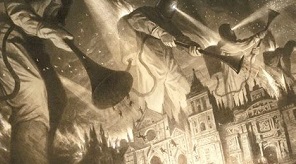
The nightmare hybrid of machine and muscle that is the hound with its needle is as much a vivid conjuration of creative construction that lends uniqueness to the world of the story as it is of the human propensity for creating monsters. The take-down of an innocent that is passed off as a successful capture of the fugitive Montag to the watching public is as much a thriller sequence of intense suspenseful chase as it is an indictment of media’s complicity with power. The way in which the group is mobilized against the individual through manipulation and fear is as much a secondary antagonist as it is an insightful portrayal of human behaviour and mass psychosis.
Bradbury knows how to tell a story first and foremost without shying away from meaningful ideas, and it makes me much more interested in reading other works by him, like The Martian Chronicles.
In the end, is 451 fahrenheit really the temperature at which paper burns? Well, it’s not wrong.
This has been my eighth Classics Club book review! Check out the rest of my list here.

If you’re interested in further reading about dystopic literature’s ideas of culture and preservation, check out this post.
 Fictitiously Yours
[…] Fahrenheit 451 (1953) by Ray Bradbury […]
LikeLike