

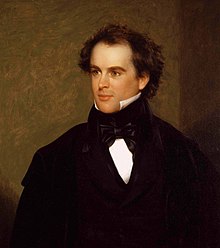
Today 160 years ago, Nathaniel Hawthorne died. Born in Salem in 1804, he was a writer of short stories and novels, American consul, and friend to contemporary writers of fiction and non-fiction alike. Among these contemporaries were Herman Melville, Ralph Waldo Emerson, and Henry Wadsworth Longfellow.
His style is characteristic of what might now be termed American Gothic, full of conflict between old and new world ideas, Puritan zeal and pagan affinities, but also develops in tandem with German romanticism of the time that had taken hold in music and art on the continent. Edgar Allen Poe, reviewing Hawthorne’s Twice-Told Tales, identified this German romantic connection by calling the style of poet Johann Luwig Tieck (1773-1853) “in some of his works, absolutely identical with that [style which is] habitual to Hawthorne.”1 And though I am not familiar with Tieck, the reason I know about him and the connection to Hawthorne is because I wrote a well-researched paper on Franz Schubert, German romanticism, and English and American romantic literature for university a few moons ago. Hence the footnote. Behold my scholarship.
[Here, you may imagine me visibly restraining myself from including more of Poe’s opinions on Hawthorne (which were many and varied), because Poe is not the topic of today’s post. As much as he likes to insert himself into everything I write…]
I fell in love with Hawthorne’s writing at 16 through reading The House of the Seven Gables and completely losing my mind at how he manages to make an entire chapter describing a house/room with only a dead occupant in it compelling. I’ve also read most of his short story collections since then, as well as most of his completed romances–The Scarlet Letter, The Blithedale Romance, and The Marble Faun.
At the crisis of my fever, I besought Hollingsworth to let nobody else enter the room, but continually to make me sensible of his own presence… then he should be the witness how courageously I would encounter the worst. It still impresses me as almost a matter of regret, that I did not die then, when I had tolerably made up my mind to it…
The Blithedale Romance by Nathaniel Hawthorne
“You are not going to die, this time,” said he gravely smiling. “You know nothing about sickness, and think your case a great deal more desperate than it is.”
“Death should take me while I am in the mood,” replied I.2
I have a fondness for Hawthorne’s spiritual drama and dark mysticism inasmuch as I appreciate his wry humour and glimmers of insight into human natures and tendencies. The quotation above is an example of that humour that stood out to me, easily identifiable and identified with. It reminds me a bit of a certain wizard Howl who estimated his own slight sniffle similarly: “‘I feel ill,’ he announced. ‘I’m going to bed, where I may die.’ He tottered piteously to the stairs. ‘Bury me beside Mrs. Pentstemmon,’ he croaked as he went up to bed.”3
Alas, all sicknesses do not conclude so lightly, as Hawthorne fell ill in the winter of 1863-64 in the midst of writing his final novel, The Dolliver Romance. Having agreed to publish it serially starting in January 1864, by the next month, in a letter to his publisher, J.T. Fields, he made this dire prediction: “I shall never finish it.”4
However, despite apparently understanding the terminal nature of his illness, unlike the character he wrote in The Blithedale Romance, Hawthorne concluded the same letter by saying, “I am not low-spirited, nor fanciful, nor freakish, but look what seem to be realities in the face, and am ready to take whatever may come.”5
Death came, three months later, to take Hawthorne, on May 19th, 1864.
- Edgar Allen Poe, The Fall of the House of Usher and Other Writings, (London: Penguin Books, 2003), 389. ↩︎
- Nathaniel Hawthorne, The Blithedale Romance, (New York: The Mershon Company, 1905?), 37. ↩︎
- Diana Wynne Jones, Howl’s Moving Castle. ↩︎
- Nathaniel Hawthorne, The Portable Hawthorne, ed. Malcolm Cowley (New York: The Viking Press, 1983), 691. ↩︎
- Hawthorne, Hawthorne: 693. ↩︎
More posts about Hawthorne and his works:
‘Let us take to ourselves no shame’
Therefore, if we built splendid castles… and pictured beautiful scenes, among the fervid coals of the hearth round which we were clustering, and if all went to rack with the crumbling embers, and have never since arisen out of the ashes, let us take to ourselves no shame. In my own behalf, I rejoice that…

“The importance of his public ends”
“[T]he besetting sin of a philanthropist, it appears to me, is apt to be a moral obliquity. His sense of honor ceases to be the sense of other honorable men. At some point of his course…he is tempted to palter with the right, and can scarcely forbear persuading himself that the importance of his public…
Dark Academia Before It Was Cool: The Marble Faun Review
It is… a perfect candidate for the label of “dark academia” with its artist main characters, themes of guilt, crime, and decay threaded with beauty and tainted love.
 Fictitiously Yours
I’ve only read The Scarlet Letter (in school) and The House of the Seven Gables. Now you have me curious about The Blithedale Romance. Perhaps it should go on my next Classics Club list if I decided to do a second round.
LikeLike
I’ve read it twice and it holds up, so I would recommend it if you’re interested!
LikeLiked by 1 person