Recently, I recognized a pattern of thought and behaviour in myself: I am long past mentally finished with a position or situation in life by the time I actually change it.
I’m currently in that mental space of being prepared to be somewhere else, while still showing up where I’m currently committed to. I can see where I’ve done this repeatedly throughout the phases of my life.
Sometimes I feel like Wharton’s protagonist that I am strangely absent from the immediate reality I find myself in, and, like him, startled to find others still imagine I am here.
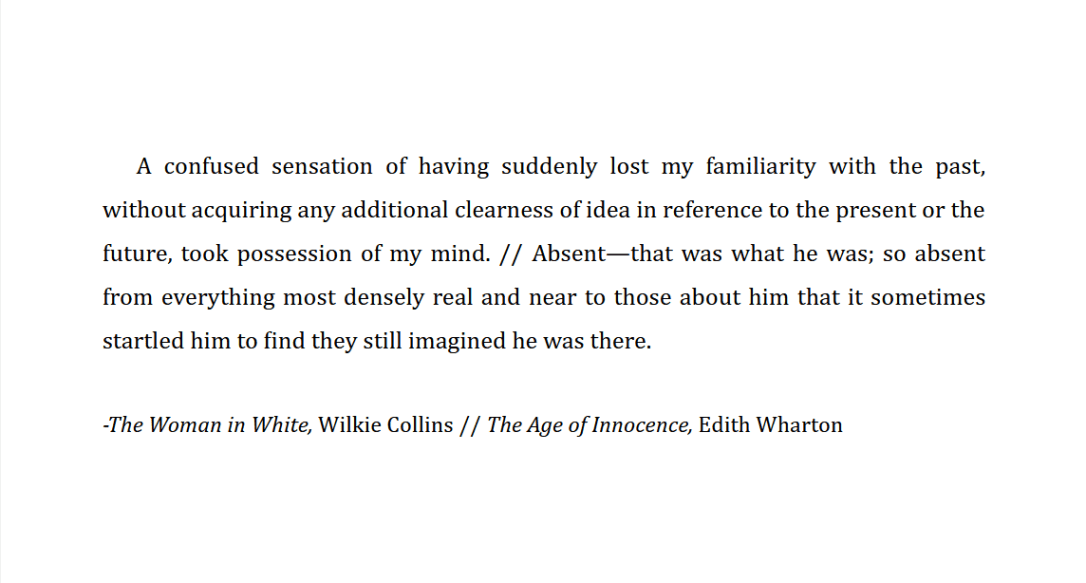
Absent—that was what he was; so absent from everything most densely real and near to those about him that it sometimes startled him to find they still imagined he was there.
The Age of Innocence
I don’t know if there is a scientific or sociological reason for this type of mentally moving-on, but I do think there’s some aspect of value to it. People go through many stages of life and have varying periods of transition for each, whether it was expected or not.
My mom has often talked about how much of a shock some of the changes in life can be, all the way from leaving one school for a new one as a child herself to changing family dynamics as her own kids grow up. She speaks about it in terms of grieving–going through stages of grief over a chapter of life that has come to a close in order to process and prepare for the new one.
I think this is important to recognize as we all deal with our own stages, in addition to having grace and understanding for others in theirs.
However, I may have escaped the more pronounced effects of the grieving aspect by developing an ability to trigger some kind of preparatory phase in my brain before the change. That way, I have already come to terms with the fact that this stage of life is not forever, and am more prepared for its end when it comes. On that side of things, it’s a plus.
The less positive side is that I tend be too quick to emotionally distance myself from the current experience, possibly leading to a disconnection from others around me. More than that, it leads to a period of limbo in which I am not fully committed to the present, but am also not physically removed from it, and so I find it hard to focus on planning tangible action for the future.
I’m mentally prepared for the next step, but without any clear idea of what that might be. This is where I relate to Collins’ narrator.
A confused sensation of having suddenly lost my familiarity with the past, without acquiring any additional clearness of idea in reference to the present or the future, took possession of my mind.
The Woman in White
Thus far in my life, I have had the fortune, one might say, or perhaps “luxury,” of finishing one thing before having to extensively plan or put next steps into action. It has been an effective way of operating for me, but has it been efficient? No.
I often feel behind in where I am in life because of the intervals I’ve taken between schooling, jobs, moving, or other things. It’s a conundrum. I feel that I have developed this coping mechanism, but it is so pronounced as to be a hinderance in different ways than the alternative would be.
Anyway, this combination of quotes has got me thinking about being more aware of how my mindset affects the way I live. It’s all well and good to enjoy the benefits, while recognising that I might need to intentionally strategise to keep it from becoming restrictive or alienating.
 Fictitiously Yours